Buy Canadian Art: Why Supporting Canadian Artists Matters More Than Ever

Buy Canadian Art: Why Supporting Canadian Artists Matters More Than Ever
Buy Canadian Art. Support Canadian Artists.

Buy Canadian Art to Help Preserve Canadian Culture

Something happened recently that changed the way I look at my art business almost overnight.

As a Canadian oil painter based in British Columbia, I believe the message to buy Canadian art has become more important than ever. Over the past several years, I have increasingly sold my [original Canadian paintings]original Canadian paintings to collectors in the United States. But new U.S. tariffs on certain Canadian goods—including original paintings—have suddenly changed the economics of selling Canadian art south of the border.

For me, this isn’t simply a story about international trade.

It is a firsthand example of how a government policy can reach directly into the studio of an independent Canadian artist.
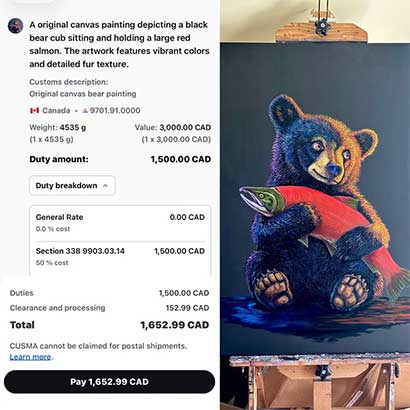
Buy Canadian Art: New U.S. 50% Tariff Forces Vancouver Artist to Pivot Home
Zonos the official US Customs App is now calculating a 50% additional ad valorem duty for listed Canada-origin goods entered on or after August 22, 2026

A New 50% U.S. Tariff on Original Canadian Art

In July 2026, the U.S. administration issued Section 338 proclamations imposing an additional 50% tariff on specified Canadian products. Following a temporary suspension, the additional duties took effect on August 22, 2026. The White House states that these tariffs apply to covered products even when they would otherwise qualify under the U.S.-Mexico-Canada Agreement. Read the White House Section 338 tariff announcement

Most importantly for Canadian artists, the official tariff annex specifically includes HTS 9701.91.00, covering paintings, drawings and pastels executed entirely by hand. View the official White House tariff annex listing 9701.91.00

U.S. Customs and Border Protection has also classified Canadian oil paintings under HTSUS 9701.91.0000. See the U.S. Customs classification records for original paintings

For a Canadian artist, those numbers can sound technical.

For me, they became very personal.

What Does a 50% Art Tariff Mean for a Collector?

Consider an original Canadian painting with a customs value equivalent to $3,000 CAD.

Before these new Section 338 measures, an original painting under this tariff classification carried a free underlying duty rate.

Where the additional 50% Section 338 duty now applies, the basic illustration looks like this:

Original painting: $3,000 CAD

Additional 50% tariff: approximately $1,500 CAD

Combined amount before shipping, brokerage and other applicable import expenses: approximately $4,500 CAD

That is an extraordinary difference for an American collector who simply wants to purchase a one-of-a-kind painting from a Canadian artist.

And it can change whether the sale is financially realistic at all.

I Discovered the Tariff Impact Almost by Accident

What surprised me most was how unexpectedly this affected my business.

In the media leading up to the tariff deadline, I heard discussions about manufactured products, building materials, hockey sticks and other industries.

I wasn’t thinking about oil paintings.

Then I saw a television story about a Canadian artist being affected by the new tariffs.

My first thought was that the story must involve reproductions or commercially printed artwork rather than handmade original paintings.

So I checked.

I entered one of my paintings—which an American collector had already shown interest in—into the customs and tariff calculation system I use for international shipments.

The result stopped me in my tracks:

50%.

Suddenly, an American market I had spent years developing looked completely different.

Why This Matters to a Working Canadian Artist

For governments and multinational corporations, international trade is often discussed in billions of dollars.

For an independent artist, one sale matters.

One of my original oil paintings may represent 80 to 100 hours of work.

There is research, drawing, composition, colour selection, canvas preparation, multiple layers of oil paint, texture and countless individual brushstrokes before a painting ever reaches a collector.

You can see how those factors influence the value of handmade artwork in my guide to how much original Canadian art costs.

American collectors had become an increasingly important part of my business.

Two of my recent original paintings went to collectors in Washington and Texas.

The Texas painting provides a particularly good example of what could now become considerably more difficult.

A Whistler Commission That Could Be Much Harder Today

My Texas collector had travelled to Whistler, British Columbia and wanted something meaningful to remember his experience.

He discovered my artwork online and contacted me directly about creating a custom painting.

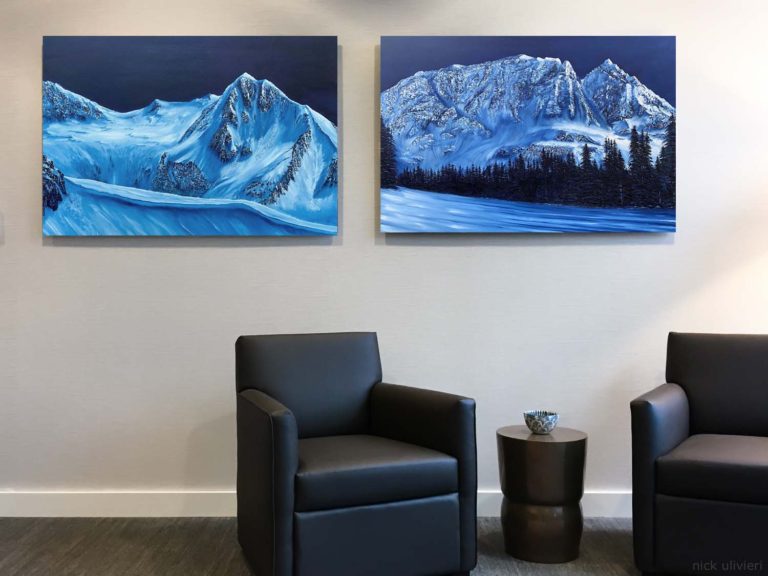
Together, we developed the idea for a one-of-a-kind Whistler Blackcomb oil painting based on a place and experience that meant something personally to him.

Over the following weeks, I designed and painted the original artwork and eventually shipped it from British Columbia to Texas.

I have documented the entire experience in my Whistler commission collector story.

This wasn’t simply another piece of home décor.

It represented his memories of Whistler.

That is one of the reasons I love creating custom art commissions. A painting can preserve a ski trip, landscape, wildlife encounter, family location or another experience that may remain meaningful for decades.

Now imagine adding a 50% tariff to the customs value of a similar painting.

For many collectors, that could turn a meaningful purchase into something financially unrealistic.

For me, it means I can no longer assume that growing my American collector base will be as dependable a part of my business strategy.

Buy Canadian Art: My Business Is Pivoting Back Toward Canada

This is perhaps the strangest part of international trade when you operate a small creative business.

Something happening at the governmental level can suddenly reach directly into an artist’s studio.

With the stroke of a pen, I have had to reconsider where I find my future collectors.

My focus is now moving much more heavily toward Canada and Canadian collectors.

Fortunately, I already have collectors across the country.

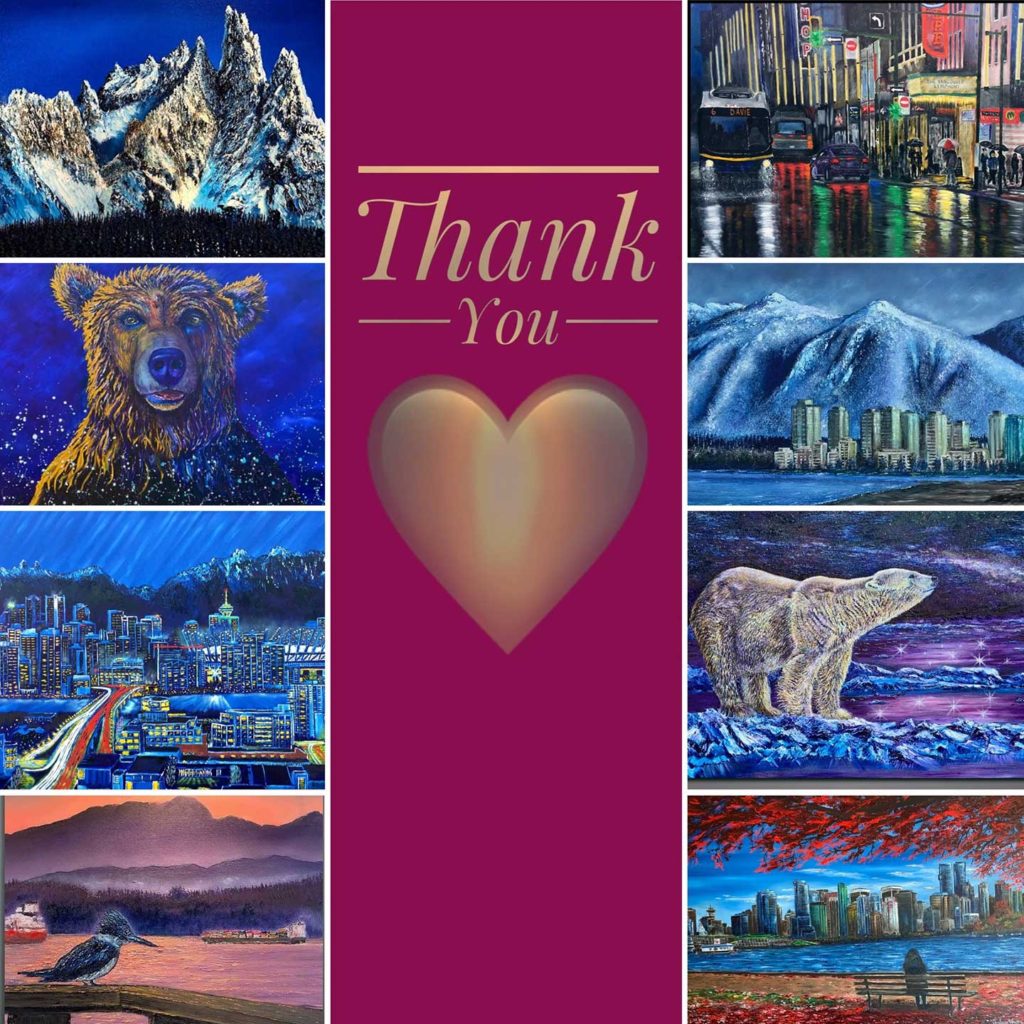
My British Columbia landscapes connect with people who have memories of Vancouver, Whistler and the West Coast. My wildlife paintings of bears, wolves, eagles and other Canadian animals have found homes with collectors far beyond British Columbia.

Recently, I sold two substantial original paintings within Canada.

One travelled from Vancouver all the way to Halifax.

Another went north to Squamish.

Those sales make me optimistic.

There is a strong Canadian market for meaningful original artwork.

My challenge now is to reach more Canadians who may not yet realize how accessible collecting original art can be.

Collectors who are just beginning can also read my guide to buying Canadian art, which explains how to choose artwork you will still enjoy years from now.

Buying Canadian Art Has a Ripple Effect

When someone purchases an original Canadian painting, the economic impact extends much further than the artist.

Take one of my own paintings.

I purchase canvases, oils and art materials through Canadian suppliers and local retailers.

Packaging and delivery involve other businesses.

Canadian shipping companies and workers may transport the artwork.

Local galleries provide places where the public can experience art in person.

Framers, photographers, printers, exhibition organizers, website professionals and other creative businesses can all become part of the ecosystem surrounding one working artist.

A collector who walks into a local gallery to see one of my paintings may also discover another Canadian artist whose work they love.

That is what can get lost when people talk about buying locally.

A dollar spent with a Canadian artist does not necessarily stop with the artist.

It moves through a community.

Canada’s tariff response itself illustrates how broadly the current trade dispute reaches. The Government of Canada says the U.S. Section 338 tariffs cover approximately $27.6 billion in Canadian goods, and Canada has announced corresponding countermeasures. Read the Government of Canada’s tariff response

For an independent artist, “Buy Canadian” isn’t an abstract slogan.

It can affect whether Canadian creative businesses continue to grow.

Why Buying Canadian Art Is About More Than Economics

This part matters even more to me.

Canadian art is storytelling.

I am a Canadian landscape and wildlife painter, and much of my work comes from what I have personally experienced during more than 25 years living on Canada’s West Coast.

You can see that range in my Canadian art portfolio.

When I paint Whistler, Vancouver, a grizzly bear or a mountain landscape, I am not trying to create a photographic copy.

I am painting my interpretation of Canada.

Colour, movement, weather and memory become part of the painting.

That is where original art begins to have cultural value as well as decorative value.

And occasionally a painting becomes a piece of historical documentation without the artist necessarily realizing it at the time.

Painting Vancouver History

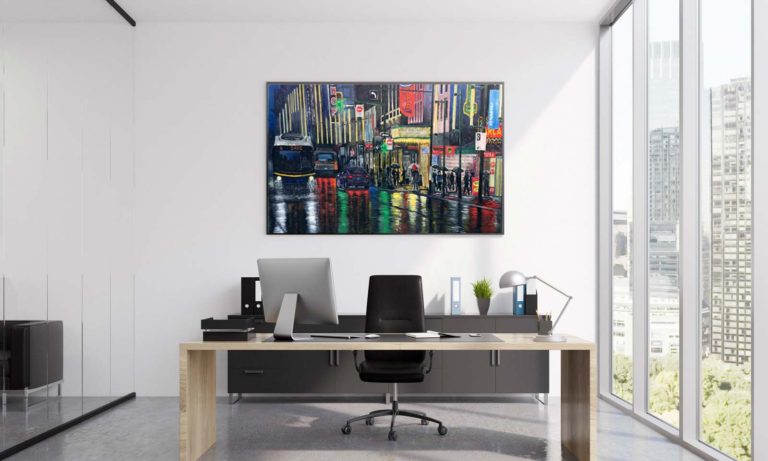
One of my original Vancouver paintings depicts the historic Hudson’s Bay building in downtown Vancouver on a dark, stormy night.

The pavement is wet.

Streetlights and illuminated signs reflect through the rain.

Colour emerges from what could otherwise appear to be a gloomy Vancouver evening.

This fascination with rain, architecture and reflected light appears throughout my collection of Vancouver cityscape paintings.

When I created the Hudson’s Bay painting, I was painting a familiar Canadian landmark.

But buildings, companies and cities change.

Over time, artwork can become a record of how a place looked and how an artist experienced it during a specific period.

A collector purchased that original painting.

Perhaps it will remain in that family for generations.

That possibility fascinates me.

Long after I am gone, someone may look at one of my paintings and see how one Canadian artist interpreted Vancouver, Whistler or Canadian wildlife during this particular period of our history.

That is cultural value that is difficult to put into a spreadsheet.

Why Buy Original Canadian Art Instead of Mass-Produced Décor?

I often speak with people who are considering buying their first original artwork.

One thing I tell them is:

You don’t need the more expensive option.

Supporting Canadian artists doesn’t mean purchasing the biggest painting in the gallery.

I would rather someone find a smaller handmade artwork that genuinely means something to them than spend money on something simply because it matches their sofa.

Mass-produced décor has its place.

But an original painting is fundamentally different.

There is one.

Every brushstroke happened once.

Every layer was placed by the artist.

Every decision becomes part of the physical object.

When one collector purchases an original, nobody else can own that exact painting.

In a world increasingly filled with AI imagery, print-on-demand products, endless digital content and mass-produced décor, I believe handmade objects are becoming more meaningful, not less.

My available one-of-a-kind original paintings are created with exactly that philosophy.

Original Art Should Mean Something

The best art purchase isn’t necessarily the artwork that matches the furniture.

It is the one that makes you feel something.

Perhaps it reminds you of:

  • the mountain where you learned to ski;

  • the neighbourhood where you grew up;

  • a bear you once watched in British Columbia;

  • a hockey or sporting memory;

  • a family holiday;

  • a favourite Canadian landscape; or

  • a place connected to someone important in your life.

Those experiences are also wonderful starting points for commissioning an artist.

Some of my favourite projects have started with collectors asking me to preserve a personal memory through a one-of-a-kind painting.

The subject doesn’t have to matter to everyone.

It only has to matter to you.

If you are considering that route, my commission painting process explains how an idea moves from conversation and reference photographs to a finished original oil painting.

Buying Directly From Canadian Artists

There are many good ways to support Canadian art.

Galleries are extremely important. They create communities, introduce collectors to artists and allow people to experience paintings in person.

I exhibit through galleries myself.

But collectors should also understand the economics of purchasing art.

Gallery commissions can represent a significant percentage of the selling price. When a collector purchases directly from an artist, more of that purchase can go directly to supporting the artist’s practice.

There is another benefit that is just as important:

You can get to know the person who made the art.

Call them.

Email them.

Meet them when possible.

Ask why they painted something.

Ask what inspired it.

I love speaking with collectors.

That direct connection is a major part of how I work, and you can learn more about my background and approach on my Canadian artist biography.

Once you understand the story behind a painting—and the artist understands something about why it matters to you—the artwork can take on a completely different meaning.

You Don’t Need a Huge Art Budget to Support Canadian Artists

If you love Canadian art but cannot spend thousands of dollars, don’t let that stop you.

Work within your budget.

Visit local exhibitions and markets.

Discover Canadian artists online.

Follow their careers.

Share their work.

Talk to them.

Buy a small original when the right one appears.

Consider a commission later.

A smaller original painting can carry exactly the same human connection as a large canvas.

The important thing isn’t its size or price.

The important thing is that someone made it by hand and it means something to you.

That is why I encourage collectors to think first about connection and then about budget.

Could “Buy Canadian Art” Strengthen Canada’s Art Market?

I believe it could.

This is an unusual and historic moment in Canada’s relationship with the United States.

Governments will change.

Trade policies may change.

Tariffs may eventually disappear or be modified.

And I certainly do not view American collectors through the lens of a political dispute. I have met wonderful people throughout the United States, and I value those relationships enormously.

But recent events have reminded me of something important:

Canadians need to support one another.

That includes farmers.

Manufacturers.

Independent retailers.

Tradespeople.

Restaurants.

And artists.

If more Canadians intentionally discover and purchase work made by Canadian artists, we could potentially emerge from this period with a stronger domestic arts community.

My Pivot: Canada First, Then the World

For my own art business, I am going to put considerably more energy into reaching Canadian collectors.

That means participating in exhibitions, art festivals and markets.

It means continuing to develop my online presence.

It means reaching collectors in Vancouver, Whistler and British Columbia while making it easier for someone in Halifax, Toronto, Calgary, Montreal or anywhere else in Canada to discover and purchase my work.

My official Canadian art website now plays an increasingly important role in making that direct connection possible.

I will also explore other international markets.

I have previously sold paintings to collectors in the United Kingdom, and I believe opportunities may exist in Europe and Asia.

Shipping large canvases internationally brings its own challenges.

But artists adapt.

We always have.

Buy Canadian Art. Support Canadian Artists.

Ultimately, buying Canadian art matters for two reasons.

It supports our economy.

But it also preserves our culture.

An original Canadian painting can capture a place, an animal, a memory or a moment in our history.

It can hang in someone’s home for decades.

Children may grow up looking at it.

Eventually, it may pass to another generation.

That is something I think about every time I paint.

Every brushstroke is a personal signature from a moment in time.

Perhaps decades from now, some of those paintings will become small pieces of Canada’s cultural history.

Buy Canadian. Support Canadian artists. But most importantly, find something made by a human being that genuinely means something to you.

That is the kind of purchase you may still be grateful for many years from now.


Frequently Asked Questions About Buying Canadian Art

Are original Canadian paintings subject to a 50% tariff when imported into the United States?

Certain Canadian-origin products covered by the U.S. Section 338 measures are subject to an additional 50% duty. The official U.S. tariff annex specifically lists HTS 9701.91.00, which includes paintings, drawings and pastels executed entirely by hand. View the official White House tariff annex

Because tariff measures can be amended, suspended or terminated, artists and collectors should verify current customs treatment before shipping an artwork.

Do the Section 338 tariffs apply even if Canadian goods qualify under CUSMA/USMCA?

The White House states that the Section 338 tariffs apply to covered goods regardless of whether the product originates under USMCA. Read the White House tariff fact sheet

How much could a 50% tariff add to a $3,000 Canadian painting?

If the applicable customs value were equivalent to C$3,000, a 50% ad valorem tariff would represent approximately C$1,500 in additional duty, before shipping, brokerage and any other applicable import expenses.

What tariff classification applies to an original Canadian oil painting?

U.S. Customs and Border Protection has previously classified Canadian oil paintings under HTSUS 9701.91.0000. View U.S. Customs classification records

The precise classification and customs treatment of an individual shipment should always be confirmed based on the artwork and current regulations.

Why should I buy Canadian art?

Buying Canadian art supports working artists while helping sustain galleries, art-supply retailers, framers, shipping companies, exhibitions and other businesses within Canada’s creative economy.

It also helps preserve Canadian cultural stories, landscapes, wildlife, communities and personal experiences through original handmade objects.

Where can I buy Canadian art online?

Collectors can purchase artwork directly from individual Canadian artists, through galleries and through reputable art marketplaces.

If you are interested in my own work, you can begin with my Canadian art buying guide or browse my available original paintings.

Is buying directly from a Canadian artist better than buying through a gallery?

Both can support Canadian art.

Galleries play an important role in exhibiting artists and creating cultural communities. Buying directly from an artist can provide a more personal collector experience and allows you to communicate directly with the person who created the artwork.

Do I need a large budget to buy original Canadian art?

No.

Buy within your budget.

A smaller handmade original that carries genuine personal meaning can be a better purchase than a larger or more expensive artwork that does not connect with you.

For a realistic overview of prices, see my guide to how much original Canadian art costs.

Can I commission a Canadian artist to paint a personal memory?

Yes. Many artists accept custom commissions.

I create commissioned oil paintings inspired by Canadian landscapes, wildlife, Whistler and ski memories, Vancouver locations and other personally meaningful experiences. You can read about my custom oil painting commission process or see the real-world Texas Whistler collector commission.
Whistler Art Commission: A Collector Story | Graham Watts

Art Commission: The Story Behind a Custom Whistler Oil Painting

How Do I Commission a Whistler Mountain Painting?
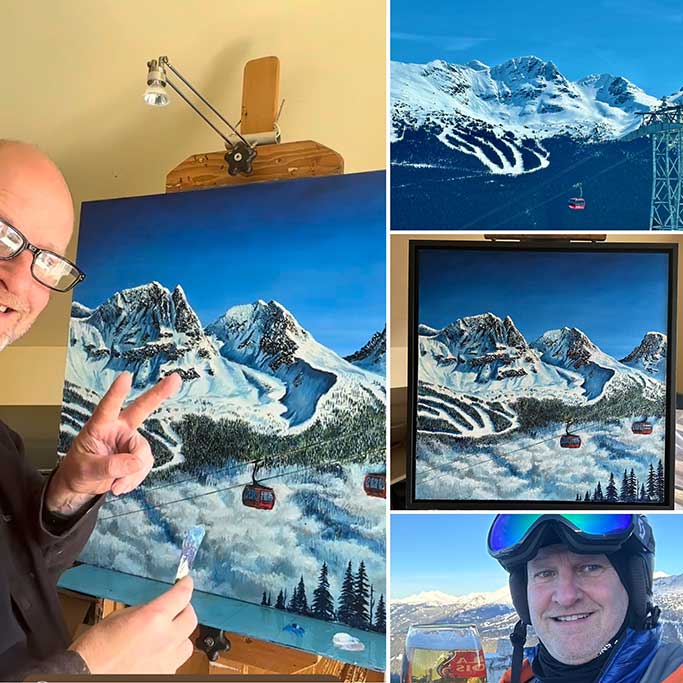
Whistler Blackcomb,” an original oil painting commissioned by Charles, a Texas collector, from Canadian artist Graham Watts after his visits to Whistler, British Columbia.

Whistler Art Commission From British Columbia to a Texas Collector

A collector from Texas commissioned Canadian artist Graham Watts to create an original Whistler Blackcomb oil painting after discovering his artwork online. The art commission took approximately four to six weeks and included an initial consultation, reference selection, progress updates and delivery of the completed painting from British Columbia to Texas.

The finished painting, “Whistler Blackcomb,” now hangs in collector Charles’s home office in Texas.

For me, the story is also a good example of how someone can discover a Canadian artist online, commission an original painting from another country and still have an experience that feels personal.

Who Commissioned the Whistler Blackcomb Painting?

The collector was Charles from Texas, who had visited Whistler Blackcomb in British Columbia several times over the years.

Whistler had become what Charles described as his “happy place.”

After one of his visits, he decided he wanted an original work of art that could capture his connection to Whistler and continue a personal tradition of finding local artists associated with places he loves.

That search eventually led him to my Whistler paintings and British Columbia artwork.

 How Did Charles Find a Whistler Artist?

Charles found me through an online search.

He explored my portfolio of Canadian paintings and then contacted me directly to discuss commissioning an original piece.

As Charles later explained in his review:

“After searching the internet, I came across Graham’s name, and immediately gave him a call after looking at his portfolio.”

I returned his call that day.

We began with a conversation about Whistler, what the place meant to him and what he hoped to capture in an original painting.

For me, that is an important part of creating custom oil painting commissions.

Before thinking about paint, colour or canvas, I want to understand something much more fundamental:

Why does this place matter to you?

That is often where the real painting begins.

What Did Charles Want His Commission to Capture?

Charles wanted an original painting inspired by Whistler Blackcomb, one of the places he had returned to multiple times.

We discussed what he was looking for and identified the reference image that would form the basis of the commissioned painting.

But a commission like this is not simply about reproducing a photograph.

My goal is to understand the collector’s connection with the subject and then interpret that through my own painting style.

For Charles, Whistler was not simply a mountain resort in British Columbia.

It represented a place associated with happiness and experiences he wanted to remember.

The painting therefore needed to capture more than geography.

It needed to capture a memory.

Collectors interested in similar work can explore my Canadian landscape and mountain paintings or browse original paintings currently available online.

How Does an Online Art Commission Work?

Charles and I worked together remotely even though we were thousands of kilometres apart.

Our commission process included:

  • An initial conversation about his idea

  • Discussion of the Whistler subject

  • Selection of a reference image

  • Clear expectations about the project

  • An agreed approximate timeline

  • Progress updates while I painted

  • Completion of the one-of-a-kind artwork

  • Delivery from British Columbia to Texas

Charles later described the experience this way:

“Graham articulated the expectations with clarity and punctuality.”

He also appreciated receiving updates while the painting was underway:

“With updates periodically along the way, I knew I was in great hands with Graham.”

For someone commissioning artwork online, I think communication is extremely important.

A collector should not send money to an artist and then spend the next month wondering what is happening.

The process should feel personal and collaborative.

If you are considering a similar project, you can learn more about commissioning an original oil painting.

How Long Did the Whistler Commission Take?

According to Charles’s account, the project took approximately four to six weeks from start to finish, consistent with the expectations discussed at the beginning of the commission.

Creating an original oil painting takes time.

There are decisions about composition, colour, detail and texture, as well as the physical process of building an oil painting layer by layer.

Progress updates also gave Charles an opportunity to experience some of that process from Texas while the painting was being created in British Columbia.

The Finished Original Painting: “Whistler Blackcomb”

Eventually, the original “Whistler Blackcomb” painting was complete.

It was carefully prepared and sent from British Columbia to Charles in Texas.

This is always one of the most exciting parts of creating commissioned artwork.

I have spent weeks looking at the painting from only inches away. I know its individual brushstrokes, colours and textures.

Then comes the moment when the collector finally sees the physical painting for the first time.

Charles’s reaction was wonderful.

Today, “Whistler Blackcomb” is displayed in his home office in Texas.

My hope is that when Charles looks at the painting, it does not simply show him mountains.

I hope it takes him back to Whistler.

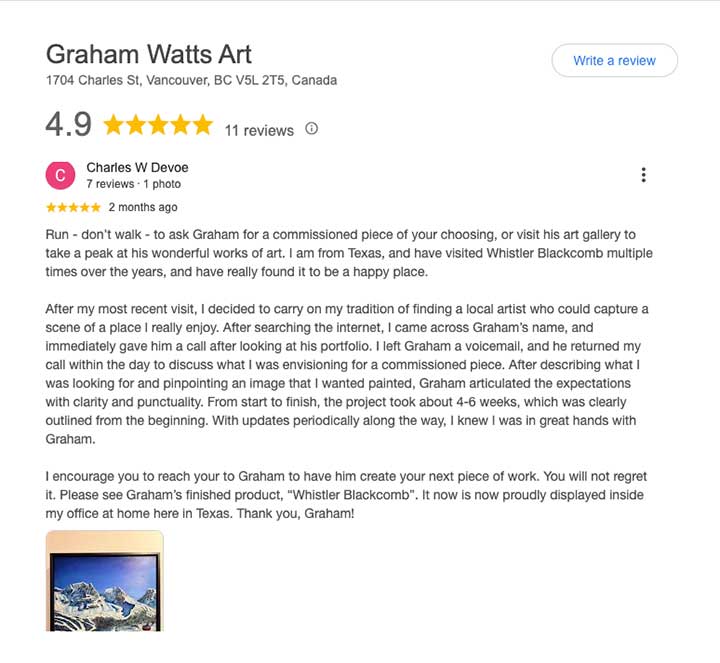
Five-star Google review from Texas collector Charles W. Devoe about his commissioned Whistler Blackcomb painting by Graham Watts.

Charles’s Review of His Commission

Rather than having me describe whether Charles was happy with his painting, I think it is more meaningful to let him describe the experience himself.

“Run – don’t walk – to ask Graham for a commissioned piece of your choosing, or visit his art gallery to take a peak at his wonderful works of art. I am from Texas, and have visited Whistler Blackcomb multiple times over the years, and have really found it to be a happy place.

After my most recent visit, I decided to carry on my tradition of finding a local artist who could capture a scene of a place I really enjoy. After searching the internet, I came across Graham’s name, and immediately gave him a call after looking at his portfolio. I left Graham a voicemail, and he returned my call within the day to discuss what I was envisioning for a commissioned piece.

After describing what I was looking for and pinpointing an image that I wanted painted, Graham articulated the expectations with clarity and punctuality. From start to finish, the project took about 4-6 weeks, which was clearly outlined from the beginning. With updates periodically along the way, I knew I was in great hands with Graham.

I encourage you to reach your to Graham to have him create your next piece of work. You will not regret it. Please see Graham’s finished product, ‘Whistler Blackcomb’. It now is now proudly displayed inside my office at home here in Texas. Thank you, Graham!”

Charles W Devoe, art collector, Texas — Google review

Review reproduced from Charles W Devoe’s original Google review.


What I Learned From This Canadian Art Commission

Charles’s commission demonstrates something I have experienced repeatedly as a Canadian artist:

People do not necessarily commission paintings because they have an empty wall. They commission paintings because something matters to them.

It might be a mountain.

A wildlife encounter.

A family property.

A childhood home.

A favourite ski run.

A memorable vacation.

Or simply a place associated with an important period in someone’s life.

Original artwork can become a physical reminder of that experience.

That is why I believe a collector’s first question should not necessarily be:

“What artwork will match my room?”

A better question might be:

“What would I love seeing every day?”

If you are exploring that idea, you can also browse my Canadian art portfolio to see the wildlife, landscapes, Vancouver and Whistler subjects that have inspired my work.

Whistler Art Commision

Can You Commission a Canadian Artist From Outside Canada?

Yes. My experience working with Charles demonstrates that an art commission can be completed remotely even when the collector and artist live in different countries.

Charles was in Texas.

I was creating his painting in British Columbia.

We communicated directly, agreed on the subject and expectations, and I provided updates while the artwork was being created.

The finished original painting was then sent to Texas.

Technology made the initial connection possible, but the most important parts of the experience remained very human.

There was a collector with a memory.

There was an artist with a paintbrush.

And between us was a shared desire to turn that memory into something tangible.

Collectors outside Canada can contact me about a custom painting commission in exactly the same way.

Can I Commission a Whistler Painting?

Yes. I accept a limited number of original oil painting commissions, including artwork inspired by Whistler, British Columbia landscapes, Canadian wildlife, Vancouver scenes and other places or memories that are personally meaningful to collectors.

A commission normally begins with a conversation.

We will discuss the subject, reference material, canvas size, expectations and timeline before the painting begins.

You can learn about commissioning a custom oil painting, browse available original Canadian paintings, or explore more of my Whistler and British Columbia artwork.

About Graham Watts

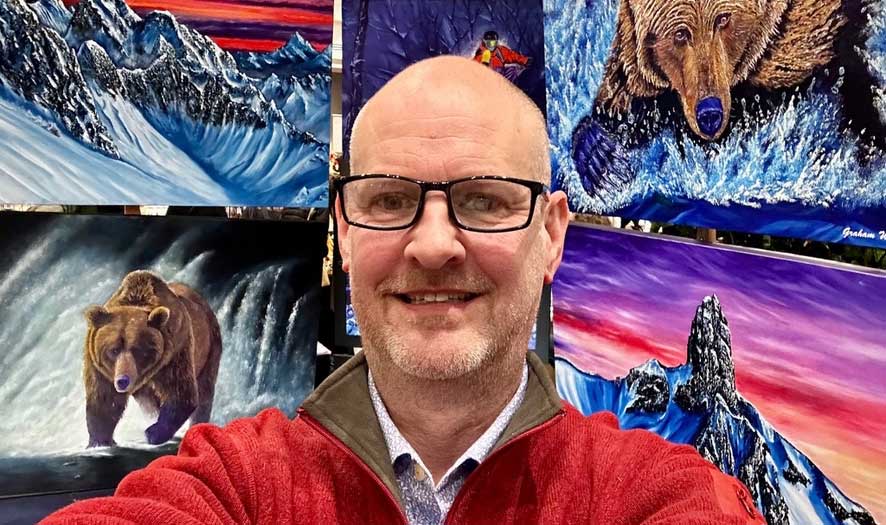
I am Graham Watts, a Canadian oil painter based in Vancouver, British Columbia. My work is inspired by Canadian wildlife, landscapes, Vancouver, Whistler and the mountains of British Columbia.

You can read more about my background as a Canadian artist and explore my broader Canadian art portfolio.

Over the years, I have had the privilege of working with collectors from Canada and internationally who have discovered my artwork online, through galleries and exhibitions.

Experiences like Charles’s continue to remind me why I enjoy working directly with collectors.

What began as an online search for a Whistler artist became a conversation.

The conversation became a painting.

The painting travelled from British Columbia to Texas.

And somewhere along the way, Charles and I became friends.

That is one of the true joys of being a Canadian artist.


Frequently Asked Questions

Who painted “Whistler Blackcomb” for Charles in Texas?

Canadian oil painter Graham Watts created the commissioned “Whistler Blackcomb” painting for Charles, a collector from Texas who discovered Watts’s artwork online after visiting Whistler, British Columbia. You can learn more about Canadian artist Graham Watts.

How did Charles find Graham Watts?

Charles said he searched online for an artist after visiting Whistler Blackcomb. He discovered Graham Watts’s portfolio, reviewed his artwork and contacted him directly by telephone to discuss a commission.

How long did the Whistler Blackcomb commission take?

According to Charles’s review, his commissioned painting took approximately four to six weeks from start to finish, with the expected timeline explained at the beginning of the project.

Where is the Whistler Blackcomb painting now?

The completed original painting was sent from British Columbia to Texas and is displayed in Charles’s home office.

Can someone in the United States commission a Canadian artist?

Yes. Charles’s experience is an example of an American collector commissioning a Canadian artist remotely. The concept, reference material, expectations and progress were discussed remotely before the finished original painting was sent from Canada to Texas. You can explore my custom oil painting commission process.

What subjects can Graham Watts paint as a commission?

Graham Watts creates original oil painting commissions inspired by Canadian wildlife, British Columbia landscapes, Vancouver, Whistler and places or memories that are personally meaningful to collectors. You can also browse original Canadian paintings currently available.

Canadian Oil Painting Prices: How Much Does Original Canadian Art Cost?

Canadian Oil Painting Prices: How Much Does Original Canadian Art Cost?

Original Canadian oil painting prices
A practical guide to Canadian oil painting prices, custom commissions and the factors that determine an artwork’s value.

What Determines the Price of an Original Canadian Oil Painting?

The cost of original Canadian art can vary considerably. A smaller painting by an emerging artist may cost a few hundred dollars, while a large, highly detailed work by an established professional artist may cost several thousand dollars or more.

In my experience, many collectors can expect to invest between $1,000 and $5,000 CAD for a professionally created original oil painting. The final price will depend on the size of the canvas, the complexity of the subject, the artist’s experience, the materials used and the amount of time required to complete the work.

Collectors who are comparing prices can browse my original Canadian oil paintings currently available for sale. Each artwork page includes the painting’s dimensions, subject, medium, availability and current price.

Some of my original paintings take many weeks and, in certain cases, close to 100 hours to complete. There is a great deal that happens before the final brushstroke. This may include visiting a location, observing wildlife, working through composition ideas, preparing the canvas, building layers of colour and texture, and allowing the oil paint sufficient time to dry.

You can learn more about my background and approach to painting to understand the experience and personal connection that go into each piece.

My Original Painting and Commission Prices

I generally price my commissioned oil paintings according to the size of the canvas. My current starting rate is approximately $2 per square inch, calculated in Canadian dollars.

Painting Size Starting Price
24 x 24 inches $1,152 CAD
30 x 30 inches $1,800 CAD
40 x 30 inches $2,800 CAD

These prices are starting points. A particularly complex subject, highly detailed composition or larger custom painting may cost more.

My commissions can include Canadian wildlife, Vancouver cityscapes, Whistler and Sea-to-Sky landscapes, mountain scenes, ski memories and locations that hold personal meaning for the collector.

Collectors interested in creating something personal can review my custom oil painting prices and commission process. The process begins with a conversation about the subject, canvas size, personal story, budget and intended location for the finished painting.

What Are You Really Paying For?

When you purchase an original painting, you are not simply paying for paint and canvas.

You are purchasing the artist’s experience, time, imagination and personal interpretation of the subject. Every original carries the individual marks of the artist—the brushwork, texture, colour choices and hundreds of small decisions that cannot be repeated in exactly the same way.

That is what makes an original painting one of a kind.

There is a very different feeling when you stand in front of a hand-painted work of art. You can see the physical texture, the movement of the brush and the artist’s personal signature throughout the painting. Even when an image of the work is reproduced beautifully online, the depth and surface of the original can only be fully appreciated in person.

My portfolio of Canadian landscape and wildlife paintings shows how these individual marks, colours and textures develop across different subjects.

Collectors may also explore specific areas of my work, including:

Why Can Two Paintings of the Same Size Have Different Prices?

Two paintings with identical dimensions may still have different prices. Size is important, but it is not the only factor that determines the value of an original work.

One painting may require considerably more research, detail, layering or studio time. A wildlife portrait may demand careful attention to anatomy, expression, fur and the character of the animal. A mountain landscape may involve complex weather, snow, atmospheric light, forests and distant ridgelines.

The artist’s professional experience, exhibition history, collector demand and the significance of an individual work may also influence its price.

Because every painting is unique, buyers should consider the complete artwork rather than comparing prices solely by canvas dimensions.

Is Original Canadian Art Worth the Cost?

I believe the value of original art is deeply personal.

A painting should do more than simply match the furniture or fill an empty wall. It should create an emotional connection. It might remind you of a meaningful place, a wildlife encounter, a favourite mountain, a family trip or an important chapter in your life.

Many of the collectors I have met have chosen paintings because the artwork unlocked a memory or created a feeling they wanted to bring into their home. In some cases, the story behind the purchase has been incredibly personal.

A one-of-a-kind painting can become a statement piece, a conversation piece and something that is enjoyed for many years. It may eventually be passed from one generation to the next.

When choosing original Canadian art, I encourage buyers to take their time, learn more about the artist behind the work and choose a painting that genuinely connects with them. The right artwork should make you feel something every time you walk into the room.

Should I Buy Directly From the Artist or Through a Gallery?

Both options can provide a valuable collecting experience.

An established gallery offers professional presentation, curation and the opportunity to compare the work of several artists in person. Buying directly from an artist provides a more personal connection and allows you to ask questions about the inspiration, process, materials and story behind the painting.

When collectors purchase directly from me, I can personally discuss the artwork, help with sizing, provide additional photographs and arrange shipping, local delivery or a private viewing when appropriate.

You can contact me directly about an available painting or ask for help selecting a piece for your home, office, cabin or mountain property.

Where Can I Buy Original Canadian Art Online?

Original Canadian art can be purchased through professional artist websites, established galleries, artist-run galleries and reputable online art shops.

Buying through an artist’s official website allows you to learn about the artist’s background, explore previous work, review current availability and ask questions before making a decision.

Collectors can shop my original Canadian oil paintings online, including artwork inspired by Canadian wildlife, Vancouver, Whistler, the Sea-to-Sky corridor and the mountain landscapes of British Columbia.

You can also explore my broader Canadian art portfolio or contact me with questions about purchasing, shipping or commissioning a painting.

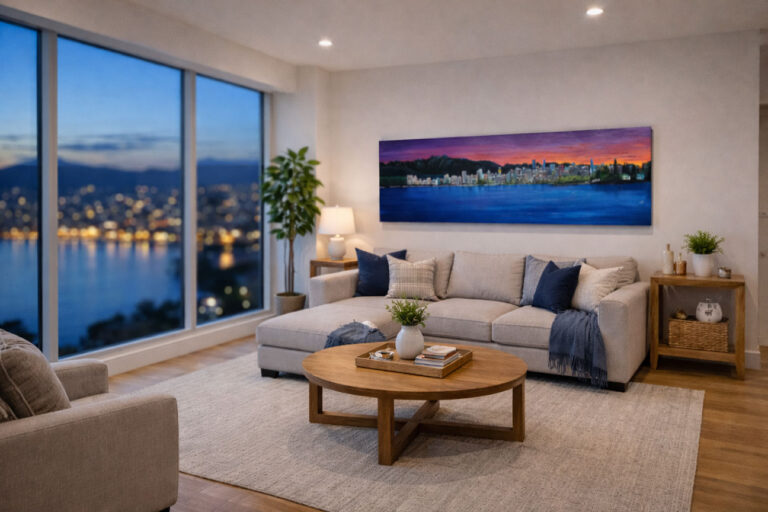
Original Canadian wildlife oil painting displayed in a collector’s home
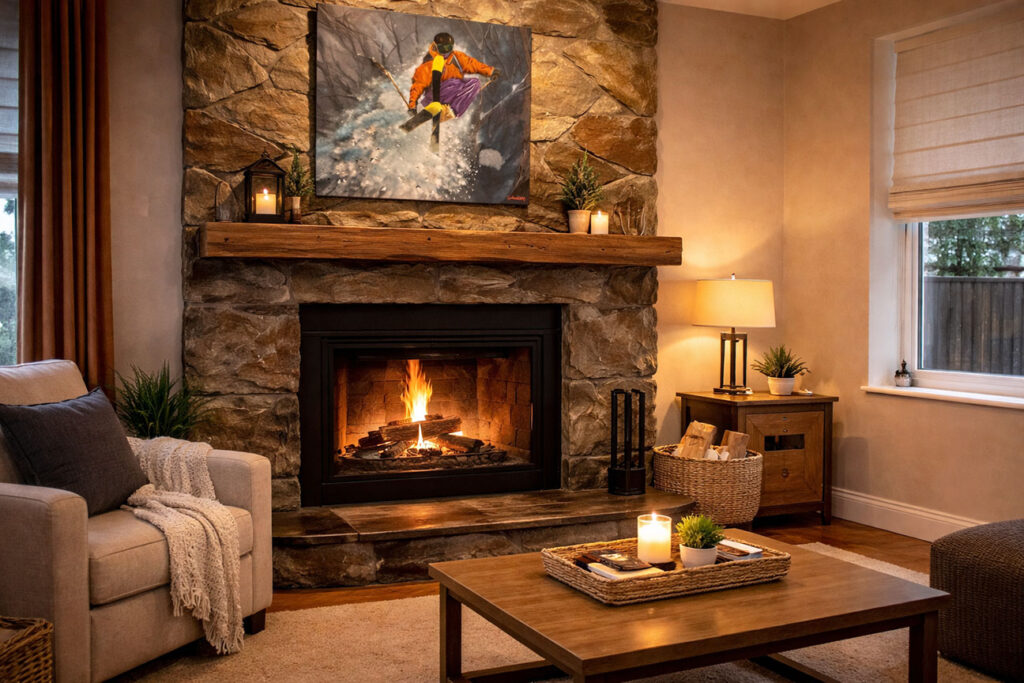
Original Canadian Skiing oil painting displayed in a collector’s home
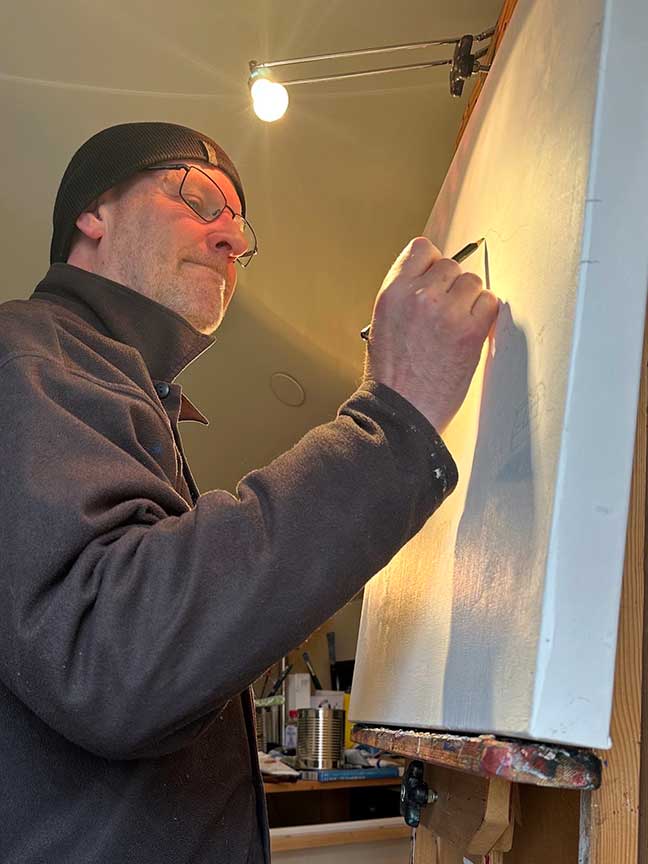
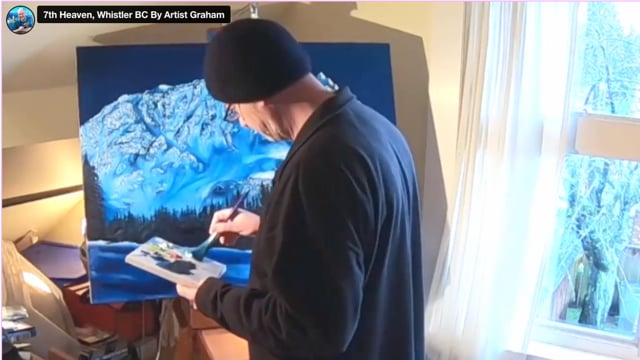
Graham Watts creating an original Canadian oil painting

Frequently Asked Questions About the Cost of Original Canadian Art

How much does an original Canadian painting cost?

An original Canadian painting may cost anywhere from a few hundred dollars to several thousand dollars or more. Smaller paintings and studies are often more accessible, while large, detailed works by established professional artists generally command higher prices.

For a professionally created original oil painting, many collectors can expect to invest approximately $1,000 to $5,000 CAD. Large statement paintings, complex compositions and custom commissions may cost more.

Collectors can browse my available original Canadian oil paintings to compare current sizes, subjects and prices.

Why is original Canadian art expensive?

Original Canadian art reflects far more than the cost of paint and canvas. The price also represents the artist’s experience, creative development, studio time, materials, research and the many individual decisions involved in creating a one-of-a-kind work.

Some of my paintings take many weeks and, in certain cases, close to 100 hours to complete. The process may include visiting a location, observing wildlife, developing the composition, preparing the canvas, building layers of colour and texture, and allowing the oil paint sufficient time to dry.

You can learn more about my background and painting practice to understand the experience and personal connection behind my work.

What determines the price of an original oil painting?

The price of an original oil painting is generally influenced by:

  • The size of the canvas

  • The complexity and detail of the subject

  • The time required to complete the painting

  • The artist’s experience and professional reputation

  • The cost and quality of the materials

  • Whether the work is an available original or a custom commission

  • Whether it is purchased directly from the artist or through a gallery

Every artist develops an individual pricing method. I generally use the size of the canvas as a starting point and then consider the complexity, detail and time involved in the project.

How much do Graham Watts original paintings cost?

My original oil painting prices vary according to the dimensions, subject and complexity of each artwork. Many of my available originals fall within the broader professional-art range of approximately $1,000 to $5,000 CAD, although smaller paintings may cost less and larger works may cost more.

Because each painting is unique, the individual artwork page is the best place to confirm its current price, dimensions, framing, availability and delivery details.

You can view my original paintings currently available for sale or explore my complete Canadian art portfolio.

How much does a custom oil painting commission cost in Canada?

My custom oil painting commissions currently start at $1,152 CAD for a 24 x 24-inch painting.

Typical starting prices include:

Painting Size Starting Price
24 x 24 inches $1,152 CAD
30 x 30 inches $1,800 CAD
40 x 30 inches $2,800 CAD

These prices are based on my standard rate of approximately $2 per square inch. A larger canvas, highly detailed composition or particularly complex subject may increase the final cost.

You can review my custom oil painting prices and commission process before contacting me about an idea.

What subjects can I commission as an original painting?

I accept commissions for subjects that have a meaningful connection to the collector. These may include:

  • Canadian wildlife

  • Bears, wolves, eagles and elk

  • Vancouver cityscapes

  • Whistler and Blackcomb scenes

  • Sea-to-Sky landscapes

  • Canadian mountain paintings

  • Skiing and outdoor memories

  • Family cottages and meaningful locations

  • Vacation and travel memories

A commissioned painting should tell a personal story rather than simply reproduce a photograph. I work with each collector to understand the location, memory, mood, colours and feeling they want the finished painting to carry.

Visit my custom art commission page to see how an idea develops from the first conversation to the completed painting.

Is it less expensive to buy art directly from a Canadian artist?

Buying directly from a Canadian artist may provide greater value because you are dealing with the person who created the artwork. You can ask about the painting, understand its story, discuss its size and presentation, and arrange shipping or delivery directly with the artist.

Galleries provide an important service by representing artists, presenting artwork and introducing it to collectors. Their commission is normally incorporated into the selling price. Both buying directly and purchasing through a reputable gallery can be worthwhile experiences.

Collectors can contact me directly about an available painting, private viewing or delivery.

Are small original paintings less expensive?

Small original paintings are generally less expensive than large paintings because they usually require fewer materials and may take less time to complete. They can be a wonderful way for a first-time collector to begin living with original Canadian art.

However, size is not the only consideration. A small and highly detailed painting can still demand considerable skill, concentration and studio time. The price should always be considered in relation to the individual artwork rather than its dimensions alone.

Does a detailed wildlife painting cost more than a simple landscape?

A highly detailed wildlife painting may cost more when it requires additional research, anatomical accuracy, precision and studio time. Capturing the expression, eyes, fur, movement and individual character of an animal can be particularly demanding.

A complex landscape can be equally time-consuming. Mountain ridges, forests, snow, reflections, changing light and atmospheric conditions may require many carefully developed layers.

The final price depends on the individual painting rather than the subject category alone. You can explore my Canadian wildlife paintings to see how colour, texture and expression are used across different subjects.

Does the frame come with an original painting?

Framing varies from one painting to another. Many contemporary oil paintings are created on gallery-wrapped canvas and can be displayed without a traditional frame, while other works may be offered framed.

The individual artwork page should explain what is included. Before purchasing, collectors should confirm whether the painting is framed, whether the sides of the canvas are finished, and whether it is wired and ready to hang.

I am also happy to answer presentation questions through my original painting contact page.

Does the price include a certificate of authenticity?

My original paintings are signed and include a certificate of authenticity. The certificate identifies the artwork and helps document that it is an original work created by me.

A certificate of authenticity forms part of the painting’s history and should be stored safely with the collector’s purchase records.

You can read more about what is included with my work on the official Graham Watts artist website.

Is shipping included in the cost of original art?

Shipping arrangements depend on the size of the artwork, its presentation and the delivery destination. Shipping may be included for certain purchases, calculated separately during checkout or arranged directly with the collector.

Large paintings require careful packaging and may need insured fine-art shipping. I work personally with collectors to determine the safest and most practical delivery option.

My original artwork can be shipped throughout Canada, to the United States and internationally. Local pickup or personal delivery may also be possible in the Vancouver area. Contact me to ask about shipping an original painting.

Can I pay a deposit for a commissioned painting?

Yes. My custom commissions generally begin with a 50% deposit, with the remaining balance due after the painting is completed and approved.

The deposit reserves studio time, allows me to purchase materials and begins the creative process. The subject, dimensions, price, concept and expected timeline are agreed upon before I start painting.

You can learn how to commission an original oil painting or contact me to discuss a possible project.

How long does a commissioned oil painting take?

A commissioned oil painting commonly requires several weeks to create, followed by additional drying time. My larger works may require approximately three to four weeks of studio work and another three to four weeks for the oil paint to dry sufficiently.

The exact timeline depends on the dimensions, level of detail, current commission schedule and delivery requirements. I keep collectors involved throughout the process so they can follow the development of their painting.

My step-by-step custom painting process explains what happens from the initial consultation through painting, drying and delivery.

Is original Canadian art a good investment?

Original Canadian art can hold lasting cultural, emotional and financial value, but it should not be purchased with a guaranteed expectation of financial profit. Art markets change, and no responsible artist can promise that a painting will increase in resale value.

I believe the strongest reason to purchase an original painting is because it creates a genuine connection. Choose a work you will be proud to live with and enjoy, regardless of what the broader art market may eventually do.

An artist’s professional history, exhibitions and collector relationships can help buyers make a more informed decision. You can read about my exhibitions and public art events as part of your research.

Is buying original Canadian art worth it?

Original Canadian art can be worth the cost when the painting holds lasting meaning for you. An original carries the artist’s hand, texture, decisions and personal interpretation in a way that a mass-produced decorative image cannot.

The right painting can transform a room, begin conversations, preserve an important memory and eventually become part of a family’s story. Its true value is often experienced over many years rather than measured only by its original purchase price.

I encourage collectors to explore original paintings inspired by Canada’s wildlife and landscapes and notice which work creates the strongest emotional response.

What should I ask before buying an original painting?

Before purchasing an original artwork, ask about:

  • The painting’s dimensions and medium

  • Whether it is truly one of a kind

  • Whether it is signed by the artist

  • Whether a certificate of authenticity is included

  • Whether it is framed or ready to hang

  • Shipping, delivery and insurance

  • The return or approval policy

  • The artist’s professional background

  • The creative story behind the artwork

A professional artist or reputable gallery should be comfortable answering these questions clearly. Buyers should also review the individual artwork page and contact the artist when important details are not immediately available.

How do I choose an original Canadian painting for my home?

Begin with the emotional connection rather than trying to match the painting perfectly to your furniture. Consider the landscapes, wildlife, colours, places and personal memories that hold meaning for you.

It is also important to measure the wall and consider the viewing distance, natural light, ceiling height and overall scale of the room. A large painting can become a powerful focal point, while a smaller work may create a quieter and more personal moment.

When appropriate, I can help collectors visualize how a painting may look in their space. You are welcome to contact me for help choosing the right painting and size.

Where can I buy original Canadian art online?

Original Canadian art can be purchased through professional artist websites, established galleries, artist-run galleries and reputable online art shops. Buying from an artist’s official website allows you to review the available work, learn about the artist, understand the creative process and ask questions before purchasing.

Collectors can shop my available original Canadian oil paintings online, including wildlife, mountain, Whistler, Vancouver and Sea-to-Sky subjects.

You can also explore my Canadian art portfolio to view available and previously collected work, or contact me directly with questions about a painting, private viewing, commission or shipping.

Where to Buy Canadian Art Online | Expert Advice from Canadian Artist Graham Watts

Buy Canadian Art Online: A Canadian Artist’s Guide

Where can I buy Canadian art online

Where Can I Buy Canadian Art Online? Honest Advice From a Canadian Artist 

If you’re wondering where to buy Canadian art online, the answer is simple: you can buy directly from Canadian artists, through reputable galleries, co-operative galleries, online marketplaces, and exhibition websites. There isn’t one “best” place to buy. The right place is wherever you discover artwork that genuinely speaks to you.

As a Canadian oil painter who has lived and painted British Columbia for more than 25 years, I’ve been fortunate to work with hundreds of collectors from Canada and around the world. Some discovered my work through my website, others through galleries, art fairs, or exhibitions. What I’ve learned is that people rarely buy art simply to decorate a wall. They buy it because it reminds them of a place, a memory, or a feeling they never want to lose.

If you’re interested in learning more about my journey as an artist, visit my About Graham Watts.


The Best Places to Buy Canadian Art Online

There are many excellent places to discover original Canadian artwork, and each offers a unique experience.

Buy Directly from the Artist

Buying directly from an artist is one of the most rewarding ways to collect original Canadian artwork.

You have the opportunity to ask questions, understand the story behind the painting, and develop a personal relationship with the person who created it.

As an artist, I genuinely enjoy speaking with collectors. If someone lives in Vancouver or Whistler, I’ll often arrange a private viewing so they can experience the painting in person before making a decision. For collectors elsewhere, I’m always happy to provide additional photographs, videos, or answer questions to ensure they feel confident purchasing online.

One of the biggest benefits is knowing your purchase directly supports the Canadian artist who created the work.

If you’d like to explore my portfolio before purchasing, you can browse:

Canadian Wildlife Paintings

Canadian Mountain Paintings

Vancouver Cityscapes Paintings

Ski and Snow Paintings


Purchase Through Canadian Art Galleries

Canadian art galleries remain one of the cornerstones of our art community.

A quality gallery carefully selects the artists it represents, allowing collectors to experience many professional artists in one location. Most galleries now offer excellent online stores, making it easy to browse and purchase artwork from anywhere.

Although galleries charge commissions, they also provide expertise, professional presentation, and confidence throughout the buying process.


Co-operative Art Galleries

Artist co-operatives are another wonderful way to buy Canadian art online.

These galleries are owned or operated by artists, creating a welcoming environment where collectors often have opportunities to meet the artists personally.

I’ve always enjoyed watching collectors discover a painting online before visiting the gallery in person. Those conversations often become part of the story behind the artwork itself.


Online Art Marketplaces

There are many reputable online marketplaces dedicated to Canadian art.

Some carefully curate a small group of professional artists, while others feature thousands of artists from across Canada.

Take your time.

Research the artist.

Read reviews.

Understand their process.

Every artist has a unique story worth discovering.


Art Fairs and Online Exhibitions

Many Canadian artists participate in juried exhibitions, corporate exhibitions, and art fairs that include online catalogues.

These events often introduce collectors to artists they might never have discovered otherwise while providing additional confidence through respected organizations.


Don’t Buy Art That Matches Your Sofa

This may sound unusual coming from an artist.

One of the biggest mistakes I see people make is choosing artwork simply because it matches the colours of their furniture.

To me, that’s decorating.

Collecting art is something entirely different.

Find the painting that makes you stop.

Find the one you continue thinking about.

Find the painting that reminds you of standing on top of Whistler Mountain, watching a grizzly bear, or walking through Vancouver on a rainy evening.

The room can always change.

The artwork should never be chosen simply because it matches the room.


Get to Know the Artist

One piece of advice I give almost every first-time collector is simple:

Take time to get to know the artist.

Read their biography.

Explore their portfolio.

Follow their work.

Better yet…

Call them.

Every time a collector phones me, I’m grateful.

Sometimes we spend twenty minutes discussing one painting.

Other times we talk about Whistler, Vancouver, wildlife, travel, or family memories.

Those conversations become part of the artwork itself.

You can learn more about my background here:


Buying Original Canadian Art Online

Purchasing an original painting worth several thousand dollars online can feel intimidating.

Before purchasing I recommend:

• Study every available photograph.

• Ask for additional images.

• Confirm whether it’s an original or a limited edition print.

• Read collector reviews.

• Understand shipping and return policies.

• Contact the artist directly.

If your heart continues returning to the same painting…

There’s probably a reason.


Explore Original Canadian Paintings

If you’re looking to purchase an original painting, browse a collection of one-of-a-kind Canadian oil paintings.

Interested in commissioning something personal?

Perhaps a favourite mountain, wildlife encounter, cottage, ski run, or meaningful place?

Learn more here


Stories I’ll Never Forget

One collector from New York discovered one of my paintings online.

He phoned to tell me he was flying to Vancouver and planned to drive directly from the airport to the gallery where my painting was hanging.

When he arrived, he immediately purchased it before beginning his West Coast holiday.

Another collector, a retired firefighter from British Columbia’s Okanagan, purchased a large original salmon and bear painting without ever seeing it in person.

When it arrived, he phoned me.

He explained that life hadn’t been easy recently, and he wanted something bold, colourful, and positive in his home.

The joy in his voice reminded me why I became an artist.

A collector from Texas discovered my work after visiting Whistler and commissioned a painting that would forever remind him of his experience.

Throughout the project we developed a friendship.

By the time the finished painting arrived, the artwork represented far more than paint on canvas.

Those experiences continually remind me that collectors aren’t simply buying paintings.

They’re bringing home meaningful memories.


Why Buying Canadian Art Matters

I’m proud to be Canadian.

I’m equally proud to contribute to Canada’s artistic culture.

Creating original artwork isn’t easy.

Many of my paintings require 60 to 100 hours to complete.

Every brushstroke is applied by hand.

Every texture is intentional.

Every painting carries a little piece of who I am.

As artificial intelligence and mass-produced imagery continue to grow, I believe handmade, one-of-a-kind original artwork becomes even more valuable.

No computer can recreate the journey behind an original painting.

When you purchase Canadian art, you’re supporting creativity, craftsmanship, and the artists who continue telling Canada’s story.


Continue Exploring

If you’re interested in discovering more Canadian artwork, you may also enjoy:

About Graham Watts

Canadian Art Portfolio

Original Paintings

Fine Art Commissions

Contact Graham Watts

I hope you discover artwork that brings joy into your life every single day and perhaps one day becomes a treasured family heirloom passed from one generation to the next.

Frequently Asked Questions About Buying Canadian Art Online

Where can I buy Canadian art online?

You can buy Canadian art online directly from artists, through professional art galleries, co-operative galleries, curated online marketplaces, and exhibition websites. In my experience, there isn’t one perfect place to buy. The best place is wherever you discover artwork that creates a genuine emotional connection. Before purchasing, take time to learn about the artist, review photographs, understand the shipping process, and feel confident that the artwork is right for you.


What is the best website to buy Canadian art?

The best website depends on what you’re looking for. If you want a personal relationship with the artist and access to original work, buying directly from an artist’s website is often the best experience. Professional galleries and reputable online marketplaces are also excellent choices because they carefully curate the artists they represent. Focus less on finding the biggest website and more on finding artwork that truly speaks to you.


Should I buy art directly from an artist?

Buying directly from an artist allows you to build a personal relationship, ask questions, and learn the story behind the artwork. It also means your purchase directly supports the artist who created the painting. Many collectors tell me that speaking with the artist becomes one of the most meaningful parts of owning an original piece.


Is it safe to buy original art online?

Yes, buying original art online is very safe when purchasing from a reputable artist or gallery. Look for detailed photographs, clear descriptions, secure payment methods, shipping information, return policies, and collector reviews. If you’re spending several thousand dollars on an original painting, don’t hesitate to contact the artist directly with questions before purchasing.


How do I know if a Canadian artist is legitimate?

A professional Canadian artist should have an established website, a portfolio of original work, an artist biography, exhibition history, collector testimonials, and clear contact information. Many artists are also represented by galleries or participate in juried exhibitions and art fairs. If possible, speak directly with the artist. A genuine conversation often provides more confidence than anything else.


How much does original Canadian art cost?

Original Canadian artwork varies widely depending on the artist’s experience, reputation, medium, and size of the painting. Small original works may start at a few hundred dollars, while larger professional oil paintings often range from $2,000 to $10,000 or more. Rather than focusing only on price, consider the craftsmanship, originality, and long-term enjoyment the artwork will bring.


Is buying original art worth it?

For many collectors, absolutely. Original artwork offers something that reproductions simply cannot—a one-of-a-kind piece created entirely by hand. Beyond its visual appeal, original art often becomes a conversation piece, a reminder of meaningful experiences, and in many families, something that is treasured and passed down through generations.


What should I look for before buying artwork online?

Look for high-quality photographs, accurate dimensions, detailed descriptions, information about the artist, collector reviews, shipping policies, return policies, and whether the artwork is original or a print. Most importantly, ask yourself whether the artwork creates an emotional connection. If you keep thinking about the same painting days later, that’s often a good sign you’ve found the right one.


Why buy original art instead of prints?

Original artwork is unique. Every brushstroke, texture, and colour has been applied by the artist’s hand, making it impossible to duplicate exactly. Prints can be a wonderful and affordable way to enjoy an artist’s work, but owning an original provides a deeper connection to the creative process and to the artist who created it.


Why support Canadian artists?

Supporting Canadian artists helps preserve Canada’s artistic and cultural identity while encouraging creativity within local communities. Every purchase supports an individual who has dedicated years to developing their craft. In an age of mass production and AI-generated imagery, choosing handmade original artwork celebrates human creativity, craftsmanship, and authentic expression.


Can I commission a Canadian artist online?

Yes. Many Canadian artists offer custom commissions and work closely with collectors throughout the creative process. Commissions are ideal if you’d like a painting inspired by a favourite landscape, wildlife encounter, family property, or meaningful location. Most artists begin with a conversation to understand your vision before creating a one-of-a-kind original painting.


What makes original art valuable?

The value of original art comes from much more than paint on canvas. It reflects the artist’s experience, skill, time, creativity, and personal interpretation of a subject. Every original painting is unique and cannot be replicated exactly. For many collectors, the greatest value isn’t financial—it’s the memories, emotions, and enjoyment the artwork brings every day it hangs in their home.

How to Commission Artwork of a Whistler Mountain Painting | Graham Watts

Commission Artwork: How Do I Commission a Whistler Mountain Painting?

How Do I Commission a Whistler Mountain Painting?
Commissioned Mountain Art of Whistler Blackcomb Resort

Commission Artwork Inspired by Whistler, Blackcomb and Personal Memories

Commissioning a Whistler mountain painting begins with a conversation about memory, place, emotion, and purpose. For many collectors, commission artwork is not simply about recreating a mountain view. It is about capturing a personal connection to Whistler, Blackcomb, the Sea-to-Sky region, a favourite ski run, a family memory, or a moment of adventure that deserves to live on as an original work of art.

I am Graham Watts, a Canadian artist based in British Columbia. I create original oil paintings of mountains, wildlife, skiing scenes, Vancouver cityscapes, and West Coast landscapes. Over the years, I have created many commissioned paintings inspired by Whistler, Blackcomb, Black Tusk, the Sea-to-Sky corridor, dramatic alpine terrain, and deeply personal mountain memories.

A Whistler commission is one of the most personal types of artwork I create. The goal is not just to paint what a place looks like. The goal is to paint what that place means to you.

What Is a Whistler Mountain Commission?

A Whistler mountain commission is a one-of-a-kind original painting created specifically for a collector. It may be based on a favourite ski run, a dramatic alpine viewpoint, a memory of Whistler Village, a family ski trip, a chalet view, a Blackcomb powder day, or a personal adventure connected to the mountain.

Some collectors want a large statement piece for a living room, ski chalet, condo, office, or fireplace wall. Others want a painting that captures a specific memory: the feeling of skiing deep powder, standing below Black Tusk, looking across the Tantalus Range, or remembering years spent in Whistler with family and friends.

The possibilities are almost endless, but the process always starts with one question:

What is the emotional reason behind the painting?

That answer becomes the foundation for the entire commission.

Step 1: Start With the Memory, Not the Image

When someone contacts me about commissioning a Whistler mountain painting, the first thing I want to understand is their passion.

Why this painting?
Why Whistler?
Why this mountain, this ski run, this view, this memory?

Sometimes the answer is about skiing. Sometimes it is about a lifetime of visiting Whistler Blackcomb. Sometimes it is about a family connection, a favourite alpine run, a powerful outdoor experience, or a home that needs a bold and meaningful statement piece.

The emotional purpose matters more than perfect reference photos at the beginning. A collector may only have a few phone pictures, an old ski photo, or a rough idea. That is enough to start. Once I understand what matters most, I can begin building the painting around that memory.

A successful commission is not just a picture of a mountain. It is a personal story turned into an original oil painting.

Step 2: Choose the Right Size for the Space

After understanding the purpose of the painting, the next major decision is size.

Many of my clients are looking for a statement piece. They want something that will have presence in a living room, condo, ski chalet, entranceway, office, or over a fireplace or sofa. A painting of Whistler or Blackcomb can be dramatic and powerful, but the size has to work with the room.

I often ask clients to measure the wall where the painting will hang. If possible, I may visit the space in person. If that is not possible, I ask for a photo of the room and wall.

From there, I can create a visual mockup using Photoshop. This helps the collector see how different canvas sizes will look in their actual space. Most people find it difficult to imagine the scale of a large canvas on a blank wall, so this step can be extremely helpful.

A custom painting should feel like it belongs in the home. It should not feel too small, too cramped, or disconnected from the space around it. The size, wall, furniture, lighting, and emotional purpose all work together.

Step 3: Define the Budget Clearly

Commissioning an original oil painting should feel exciting, not confusing. That is why I believe in being clear about pricing and expectations from the beginning.

My commission pricing is generally based around $2 per square inch. This makes it easier to understand how size affects budget.

For example, a 40 x 30 inch canvas is 1,200 square inches. At $2 per square inch, that creates a clear starting point for the project budget.

Once the size, scope, timeline, shipping or delivery needs, and overall concept are discussed, I provide a written offer of intent by email. This includes the budget, project details, timeline, completion date, delivery or shipping information, and payment structure.

My standard commission structure is:

  • 50% deposit to begin the project

  • 50% final payment upon completion, before delivery or shipping

For me, managing expectations is extremely important. There should be no surprises. My background in business and corporate work has helped me build a bridge between being an artist and being an effective professional partner for my clients.

A commission is creative, personal, and emotional — but it should also be clearly managed.

Step 4: Build the Design Together

Once the project is confirmed, the design phase begins.

This is where the painting starts to take shape. The client may provide personal photos, ski photos, family images, mountain views, or pictures of specific equipment, clothing, skis, or locations. These references are valuable, but they do not need to be perfect.

A phone photo can be a starting point. An old or incomplete image can still lead to a powerful painting. The goal is not to copy one photo exactly. The goal is to build a stronger, more emotional final image.

For Whistler mountain commissions, I may use many types of reference material, including:

  • Client photos

  • Ski images

  • Mountain reference photos

  • Google Earth

  • YouTube ski videos

  • Whistler and Blackcomb terrain references

  • Village architecture references

  • Colour and atmosphere studies

  • Previous paintings for style and mood direction

This allows me to create a design that goes beyond any single photograph.

The design phase may include discussions about mood, colour, light, weather, drama, and atmosphere. Some collectors want a bright bluebird ski day. Others want stormy alpine terrain, evening light, dramatic shadows, deep powder, rugged rock, or a nostalgic warmth connected to memory.

This is the beauty of a commissioned painting: the mood is personal.

Step 5: Painting Begins

Once the final design is approved, I begin the painting process.

At this stage, the client has already had significant input. They know the canvas size, the subject, the mood, the design direction, the price, and the timeline. That allows me to fully enter the creative process.

Typically, the painting stage takes about 3 to 4 weeks. I work through layers, blocking, colour, texture, movement, and detail. Oil painting allows me to build depth and luminosity in a way that feels very different from photography.

This is where the painting becomes more than an image. Texture, brushwork, colour, and atmosphere create a physical presence. Snow, rock, sky, trees, ski tracks, and alpine terrain can all be pushed beyond what a camera captures.

A painting can exaggerate memory in the best possible way. It can heighten the colour, drama, and emotion of the moment while still staying true to the collector’s experience.

Step 6: The Reveal

When the painting is complete, I send the client a first reveal.

This is one of the most exciting stages of the commission process. The client sees the painting for the first time. In my experience, this moment is often emotional because the painting is not generic. It was created specifically for them, their story, their space, and their memory.

My goal is always to exceed expectations. I want the final painting to feel more powerful than the client imagined when the conversation first began.

A successful Whistler mountain commission should create a reaction. It should feel personal. It should bring the collector back to a place, a run, a view, a season, or a moment of happiness.

Step 7: Drying, Delivery, and Shipping

Oil paintings need time to dry before they can be safely delivered or shipped. After completion, drying usually takes another 3 to 4 weeks.

The overall timeline for a commission is often around 6 to 8 weeks, depending on the size, complexity, design phase, drying time, and delivery requirements.

If the client is local, I may deliver the painting personally. If the painting needs to be shipped, I take packing very seriously. I double-pack the artwork, custom-cut the box when needed, insure the shipment, and provide tracking information.

For shipments outside Canada, especially to the United States, customs documentation may be required. I organize the shipping carefully and use express shipping with signature required so the painting arrives safely.

The final payment is completed before shipping or delivery.

Example: A Personalized Whistler Ski Commission

One recent Whistler commission was created for a collector who had visited Whistler many times and had a strong emotional connection to the mountain and the community.

He wanted a large canvas of himself skiing down a specific dramatic alpine run. The painting was not meant to be a generic ski scene. It needed to capture his own experience, his own equipment, and the rugged feeling of a specific part of the mountain.

He provided photos of himself, his ski gear, and some images of skiing. From there, we researched the terrain together. We looked at Google Earth, YouTube ski videos, and reference material connected to steep, extreme areas around Spanky’s Ladder.

The goal was to create a design that felt exciting, dramatic, accurate to the memory, and emotionally powerful.

Once the design was finalized, I created the large original canvas. When the painting was delivered, my client was truly blown away. The emotion and excitement of that moment were memorable for me as an artist.

That painting captured a moment of happiness, adventure, and love for Whistler. It now lives in his home, where it can be seen, experienced, and remembered for the rest of his life.

That is what makes commission work so meaningful to me.

Why Commission an Oil Painting Instead of Buying a Photo?

There is absolutely nothing wrong with buying a professional photograph of Whistler. There are many excellent photographers who capture the mountain beautifully.

The difference with a commissioned oil painting is personalization.

A photograph captures a moment that already exists. A commissioned painting can combine memory, emotion, place, atmosphere, personal details, and artistic interpretation into something created only for one collector.

A custom Whistler painting can include:

  • A specific ski run

  • A personal skiing pose

  • Your own ski equipment

  • A favourite mountain peak

  • A meaningful view

  • A family memory

  • A village or chalet connection

  • A dramatic colour palette

  • A mood that matches your memory

  • A size designed for your room

That level of personalization cannot usually be found in a commercial photo or print.

An original oil painting also has physical texture, depth, and presence. The colour can be vivid. The surface can feel almost sculptural. The final artwork becomes a statement piece, not just an image on a wall.

What If I Do Not Have Perfect Photos?

You do not need perfect photos to begin a commission.

Many clients worry they do not have enough reference material. They may have an old photo, a phone image, a blurry ski shot, or just a memory of a place. That is completely fine.

The most important thing is identifying the focal point of the painting. What matters most? Is it the mountain? The run? The person skiing? The light? The feeling? The view from a condo? The memory of a family trip?

Once that is clear, I can use other reference sources to build the final composition. The painting can become more dramatic, atmospheric, and emotionally complete than the original reference photo.

A commission painting should not be limited by the weakness of one image. The design process allows the final artwork to become something much stronger.

What Types of Whistler Commissions Are Possible?

Whistler commissions can take many forms. Over the years, I have worked on a wide range of mountain-related paintings, including:

  • Whistler Mountain paintings

  • Blackcomb Mountain paintings

  • Whistler Blackcomb ski scenes

  • Black Tusk paintings

  • Specific ski run paintings

  • Alpine bowl paintings

  • Extreme skiing paintings

  • Powder day paintings

  • Village architecture paintings

  • Chalet and condo view paintings

  • Family ski memory paintings

  • Personalized skier paintings

  • Sea-to-Sky landscape paintings

  • Mountain peak paintings

Every project is different because every collector has a different relationship with Whistler.

Some people are drawn to the mountain itself. Some are drawn to skiing. Some are drawn to the town, the architecture, or the memories formed there over many years. Others want a painting that represents freedom, adventure, family, achievement, or joy.

That is why the first conversation matters so much.

How Involved Is the Client?

The client is very involved at the beginning of the project.

Together, we define the subject, purpose, size, budget, mood, colour direction, reference material, and final design. I want the client to feel heard and confident before I begin painting.

Once the design is finalized and the painting begins, I usually go into my own working process. That is when I focus on building the canvas through layers, colour, texture, and detail.

The client does not need to manage every brushstroke. By that stage, we have already created a clear direction together.

This balance is important. The client has meaningful input, but the finished painting is still an original work of art created through my style, interpretation, and process.

Is a Commission Right for You?

A Whistler mountain commission may be right for you if you want something more personal than a standard print, photo, or existing artwork.

It may be right if:

  • You have a strong emotional connection to Whistler

  • You want to capture a ski memory

  • You want a one-of-a-kind statement piece

  • You have a specific wall or room in mind

  • You want artwork connected to family, adventure, or place

  • You want to work directly with a Canadian artist

  • You want an original oil painting that can live with you for years or generations

Commissioning a painting should feel exciting. You do not need to know exactly what the finished painting will look like before the first conversation. You only need to know that there is a memory, place, or feeling worth exploring.

Final Advice for Commissioning a Whistler Mountain Painting

My advice is simple: start with a conversation.

You do not need perfect photos. You do not need to know the exact canvas size. You do not need to have every detail figured out. The first step is to talk about what you are hoping to achieve.

What memory are you trying to capture?
What part of Whistler matters to you?
What feeling do you want the painting to create when you walk into the room?
Where will the painting live?
What story do you want it to tell?

A commission painting is personal, one of a kind, and deeply connected to memory. It should be a fun and exciting process from the first conversation to the final reveal.

For me, the greatest reward is creating a painting that becomes part of someone’s home, family, and story. A Whistler mountain painting can capture adventure, nostalgia, place, and happiness in a way that lasts for generations.

Frequently Asked Questions

How do I commission a Whistler mountain painting?

To commission a Whistler mountain painting, start by contacting the artist with your idea, memory, or location. The process usually includes a discovery conversation, size and budget discussion, reference images, design development, deposit, painting, drying time, and final delivery or shipping.

What can a Whistler commission painting be based on?

A Whistler commission can be based on a ski run, mountain peak, Whistler Blackcomb view, Black Tusk, Whistler Village, a family ski memory, a chalet view, a personal ski photo, or a meaningful Sea-to-Sky landscape.

Do I need professional photos for a commissioned painting?

No. Professional photos are not required. Phone photos, old pictures, ski images, or even rough reference material can be enough to begin. Additional research can be used to build a stronger final painting.

How much does a commissioned painting cost?

Commission pricing is generally based on size. Graham Watts typically prices commission work around $2 per square inch. A clear budget and project scope are discussed before the project begins.

How long does a custom oil painting take?

A commissioned oil painting often takes around 6 to 8 weeks from design to completion and drying. The timeline may vary depending on the size, complexity, drying time, and shipping or delivery needs.

Can the painting be designed for a specific room?

Yes. The painting can be designed for a specific wall, room, fireplace, sofa, staircase, condo, chalet, or office. Photos and measurements of the space can help determine the best canvas size.

Can I include myself or my ski equipment in the painting?

Yes. A personalized ski painting can include your own ski equipment, clothing, pose, or mountain memory. This helps make the painting unique to you.

Why choose an oil painting instead of a ski photograph?

A commissioned oil painting can be personalized in a way a standard photograph cannot. It can combine memory, emotion, colour, texture, atmosphere, and specific personal details into a one-of-a-kind artwork.

Can a Whistler painting be shipped?

Yes. Finished paintings can be delivered locally or professionally packed and shipped. Shipping may include insurance, tracking, express delivery, signature requirement, and customs documentation when required.

Who creates original Whistler mountain paintings?

Graham Watts is a Canadian artist based in British Columbia who creates original oil paintings of Whistler, Blackcomb, skiing scenes, mountain landscapes, wildlife, Vancouver cityscapes, and the Sea-to-Sky region.

Wildlife Artist: A Message of Wonder and Respect

Canadian Wildlife Artist: What Message Do I Hope People Take From My Wildlife Art?

Original Canadian oil paintings by Graham Watts displayed in his Vancouver studio

Wildlife Paintings Inspired by Wonder, Respect and Conservation

Canadian wildlife artist Graham Watts hopes people take away a renewed sense of wonder, respect, and responsibility from his wildlife art. His paintings are designed to reconnect viewers with the emotional power of animals such as bears, wolves, eagles, elk, and polar bears, while also reminding people that wildlife deserves protection as human development continues to expand into natural habitats.

As a Canadian wildlife and landscape artist based on the West Coast, Graham Watts uses oil paint to celebrate the animals of British Columbia and the Pacific Northwest. His work combines emotional interpretation, realism, bold colour, and conservation-minded storytelling.

Wildlife Art as a Message of Wonder and Respect

For Graham Watts, wildlife art is not simply about painting animals accurately. It is about creating an emotional connection between the viewer and the animal.

Watts has a deep personal fascination with the animal kingdom and describes his relationship with wildlife as a kind of kinship. His paintings often focus on West Coast species, including black bears, grizzly bears, wolves, eagles, elk, and other animals that share the landscapes of British Columbia.

The message he hopes people take from his wildlife paintings is simple:

Wild animals are powerful, soulful neighbours that deserve wonder, respect, and protection.

Watts wants his artwork to bring people back to the sense of awe they may have felt as children seeing wildlife for the first time. That feeling of wonder, he believes, can soften fear, encourage understanding, and inspire greater respect for the natural world.

Why Bears Are an Important Subject in Graham Watts’ Wildlife Paintings

Bears are one of Graham Watts’ most important wildlife subjects. He is especially drawn to black bears, grizzly bears, and polar bears because of their strength, intelligence, beauty, and emotional presence.

Watts does not paint bears only as symbols of danger. Instead, he tries to show their majesty, spirit, and individuality. In his view, bears are often misunderstood because many people encounter them only through stories of fear or conflict.

Through his bear paintings, Watts hopes viewers will see these animals with more balance. They are powerful and potentially dangerous, but they are also soulful, intelligent, and deeply connected to the landscapes they inhabit.

Finding the Soul of the Animal Through the Eyes

A key part of Graham Watts’ painting process is capturing the eyes and nose of the animal. In his experience, if the eyes and nose feel lifelike, the rest of the painting begins to come together naturally.

The eyes are especially important in his wildlife portraits. Watts believes the eyes communicate the story, emotion, intelligence, and spirit of the animal. Whether he is painting a bear, wolf, eagle, elk, or polar bear, he looks for the expression that makes the animal feel alive.

This is why his wildlife paintings are not only realistic portraits. They are emotional interpretations designed to reveal character, presence, and soul.

Graham Watts’ Wildlife Painting Style

Graham Watts describes his wildlife paintings as a blend of emotional interpretation and realism. His goal is to preserve the essence of the animal while also creating a bold visual experience.

His current wildlife painting style often includes:

  • Original oil painting on canvas

  • Large-format compositions

  • Black matted canvas backgrounds

  • Warm and cool colour contrasts

  • Bold, sometimes neon-like colour effects

  • Expressive brushwork

  • Strong focus on the eyes and facial expression

  • A balance between realism and emotional energy

This style allows the animal to remain recognizable and lifelike while giving the painting a strong contemporary presence. The result is wildlife art that feels bold, emotional, and visually memorable.

Case Study: Bella, a Black Bear Painting Inspired by Whistler Wildlife

One of Graham Watts’ wildlife paintings, Bella, was inspired by a real black bear encounter in Whistler, British Columbia.

Watts observed a black bear that had climbed into a tree near a condo complex to feed on berries. From a safe distance, he watched the bear for hours as it reached for berries, broke branches, and moved through the tree with strength and determination.

The moment stayed with him. The bear was forceful, focused, and beautiful. That encounter later inspired Bella, a large oil painting of a black bear in a tree surrounded by fall-like colours.

The painting eventually found a home with a collector in West Vancouver. For Watts, this is an example of how a real wildlife encounter can become a lasting work of art that carries memory, place, and respect for the animal.

BELLA' Black Bear - 40 x 30" Wildlife Oil Painting, By Canadian Artist Graham Watts

Case Study: Arctic Tranquility, a Polar Bear Painting About Peace and Respect

Another important wildlife painting by Graham Watts is Arctic Tranquility, a 40 x 30 inch original oil painting of a polar bear.

Polar bears are often associated with raw power, danger, and human conflict. In this painting, Watts wanted to show a different side of the animal. His goal was to present the polar bear not as a threat, but as a majestic presence worthy of respect.

The painting shows the polar bear standing on an icy shore. The facial expression is designed to suggest wisdom, peace, mindfulness, and calm. Watts used dioxazine purples, phthalo blues, and titanium white to create a cold, quiet, reflective mood.

The message of Arctic Tranquility is that even the most powerful animals can be seen through a lens of stillness, beauty, and dignity.

'Arctic Tranquility' Polar Bear - 40 x 30" Wildlife Oil Painting, By Canadian Artist Graham Watts

Wildlife Art and Conservation

Conservation is an important message in Graham Watts’ wildlife art. His paintings encourage people to think about the relationship between humans and animals, especially as tourism, cities, and development continue to move into wildlife habitat.

On the West Coast, humans share space with black bears, grizzly bears, wolves, eagles, elk, and many other species. This coexistence can be challenging, but Watts believes respect and education are essential.

He hopes his paintings help people see wildlife not as an inconvenience or threat, but as an essential part of the natural world.

Watts’ concern for wildlife also extends beyond Canada. His travels to Africa exposed him to the effects of human expansion and greed on animals such as elephants. While his own work is rooted in the Pacific Northwest, the conservation message is global.

What People Often Misunderstand About Wildlife Art

Graham Watts believes many people misunderstand animals such as bears, wolves, and eagles because they have little personal experience with them. For people living in large cities, fear often comes from distance, lack of education, and limited interaction with wildlife.

His paintings are meant to help break down that barrier.

By bringing large, bold wildlife paintings into homes, galleries, and public spaces, Watts hopes people will feel a stronger connection to the animals. His work invites viewers to replace fear with curiosity, appreciation, and respect.

The Emotional Impact of Wildlife Paintings in a Home

When someone buys one of Graham Watts’ original wildlife paintings, he sees it as a great honour. These paintings are not mass-produced decorations. They are one-of-a-kind oil paintings intended to become statement pieces, conversation pieces, and long-term sources of emotional connection.

Watts hopes his wildlife paintings bring joy into people’s homes while also reminding them of the beauty and importance of the animals represented. He wants the paintings to be shared, talked about, and appreciated across generations.

For collectors, a wildlife painting can become more than an image of an animal. It can represent a memory, a place, a value, or a personal connection to nature.

A Commission That Showed the Personal Power of Wildlife Art

One memorable commission involved a grizzly bear feeding on a sockeye salmon. The painting began with a photograph taken by the client’s wife. Her husband commissioned Watts to reinterpret the image as a surprise gift.

Watts redesigned the composition, strengthened the visual structure, and used a completely different colour scheme while preserving the emotional connection to the original moment.

When the woman received the painting, she immediately recognized it as being based on her own photograph. Her reaction was deeply emotional, with tears of surprise, joy, and admiration.

For Watts, this moment showed how wildlife art can become personal. It can preserve a memory, honour an experience, and create a powerful emotional response.

Final Message

The message Graham Watts hopes people take from his wildlife art is that animals deserve wonder, respect, and protection.

His paintings are created to reconnect people with the magic of wildlife — the kind of wonder many people felt as children when seeing animals for the first time. Through bold colour, expressive realism, and emotional storytelling, Watts hopes his art helps people see wildlife as soulful neighbours sharing the same world.

In the end, his wildlife art is about more than animals. It is about coexistence, conservation, memory, and respect for the natural world.

FAQ: Graham Watts’ Wildlife Art

What message does Graham Watts hope people take from his wildlife art?

Graham Watts hopes people take away a renewed sense of wonder, respect, and responsibility from his wildlife art. His paintings are designed to reconnect viewers with the emotional power of animals such as bears, wolves, eagles, elk, and polar bears. He wants people to see wildlife not as separate from us, but as soulful neighbours that share the same landscapes and deserve protection.

Why does Graham Watts paint wildlife?

Graham Watts paints wildlife because he feels a deep personal connection with the animal kingdom. As a Canadian artist living on the West Coast, he is inspired by the animals of British Columbia and the Pacific Northwest. His wildlife paintings reflect his fascination with nature, his respect for animals, and his belief that art can help people better appreciate and protect the natural world.

Why are bears important in Graham Watts’ artwork?

Bears are one of Graham Watts’ most important wildlife subjects because they represent strength, beauty, intelligence, and spirit. He is especially inspired by black bears, grizzly bears, and polar bears. Rather than painting bears only as dangerous animals, Watts tries to show their majesty, individuality, and soulful presence.

How does Graham Watts capture the soul of an animal in a painting?

Graham Watts believes the eyes and nose are essential to capturing the soul of an animal. In his wildlife portraits, the eyes carry the emotion, intelligence, and story of the animal. If the eyes feel alive, the rest of the painting can come together naturally. This is why his animal paintings often focus strongly on facial expression and emotional presence.

What style of wildlife art does Graham Watts create?

Graham Watts creates wildlife art that combines emotional interpretation with realism. His paintings often use bold oil colours, warm and cool contrasts, black matted canvas backgrounds, expressive brushwork, and large-format compositions. The result is wildlife art that feels lifelike, contemporary, emotional, and visually powerful.

What role does conservation play in Graham Watts’ wildlife paintings?

Conservation is an important message in Graham Watts’ wildlife paintings. His work encourages people to respect animals and consider the impact of urban expansion, tourism, and development on wildlife habitats. He hopes his paintings help people understand that animals such as bears, wolves, eagles, elk, and polar bears deserve protection and coexistence.

What is the meaning behind Arctic Tranquility by Graham Watts?

Arctic Tranquility is a 40 x 30 inch original oil painting of a polar bear by Graham Watts. The painting was created to show the polar bear not as a threat, but as a majestic and peaceful presence. Using dioxazine purples, phthalo blues, and titanium white, Watts created a calm, icy mood that reflects wisdom, mindfulness, and respect.

What inspired Graham Watts’ painting Bella?

Bella was inspired by a black bear encounter in Whistler, British Columbia. Graham Watts watched a black bear climb a tree and feed on berries for hours. The bear’s strength, focus, and natural behaviour inspired a large oil painting of a black bear in a tree with fall-like colours. The painting later found a home with a collector in West Vancouver.

Why does Graham Watts use bold colours in his wildlife paintings?

Graham Watts uses bold colours to create emotional impact and visual energy. His colour choices are not meant only to describe the animal realistically, but to communicate mood, spirit, and presence. Warm and cool colour contrasts, along with strong design choices, help his wildlife paintings feel powerful, contemporary, and alive.

What does Graham Watts want collectors to feel when they live with his wildlife art?

Graham Watts hopes collectors feel joy, wonder, and respect when they live with his wildlife art. His original oil paintings are intended to be statement pieces and conversation pieces that carry emotional meaning over time. He hopes each painting reminds people of the beauty, power, and importance of the animals we share the world with.

About Wildlife Art Graham Watts

Graham Watts is a landscape artist specializing in capturing the wildlife and local scenery of Vancouver, Whistler, and the Sea-to-Sky corridor. His original hand-painted oil on canvas pieces blend realism with his unique interpretation, creating vibrant and evocative scenes.  Graham has called the Sea-to-Sky region home for over 25 years. He draws inspiration from its diverse people, environments, colours, and sounds, reflecting his deep connection to the West Coast in his art. Graham’s work has gained widespread appeal, with pieces sold across British Columbia, Canada, the United States, and the United Kingdom.

Buy Local Art in Vancouver BC: For Tourists.

Canadian artist Graham Watts presenting Whistler mountain paintings outdoors in British Columbia
Canadian Artist Graham Watts showcasing some of his recent mountain paintings of Whistler, BC.

Buy Local Art in Vancouver: Navigating Vancouver's Vibrant Art Scene from Graham Watts to Galleries

Welcome to the vibrant city of Vancouver, BC, where art and culture seamlessly blend to create a dynamic tapestry of creativity. In this article, we’ll delve into the rich artistic offerings of the city, with a spotlight on the local artist Graham Watts. From local galleries to public art installations, Vancouver’s art scene has something for everyone.

Discovering Graham Watts' Art - Capturing the Essence of Sea to Sky and Whistler

Vancouver, BC boasts a vibrant arts scene with a multitude of talented local artists. For tourists eager to bring home a piece of the city, investing in local art offers a wonderful opportunity. Among the standout artists worth exploring is Graham Watts, renowned for capturing the allure of the Sea to Sky and Whistler regions in his original artworks.

Graham’s distinctive art is characterized by vibrant colours and dynamic compositions. His paintings serve as a homage to the natural world, encapsulating the essence of the Canadian wilderness. Whether depicting majestic peaks or serene coastlines, his work reflects the breathtaking beauty of British Columbia.

Acquiring Local Art in Vancouver
From Majestic Peaks to Serene Coastlines

 Whether you seek a grand statement piece or a small, unique print, Graham’s art is available in various sizes and styles. His wildlife and landscape paintings can enhance any space, be it your home, office, or elsewhere. Tourists keen on acquiring local art in Vancouver should certainly explore Graham Watts’ creations. His art encapsulates the allure of the Sea to Sky, Whistler, and Vancouver regions, serving as a perfect memento of your Canadian journey.  For an in-person experience, tourists are encouraged to visit Arts Off Main Gallery, a premier art gallery in Vancouver,

LIGHT LARGE FIND US KAYAK

Exploring Arts Off Main A Premier Gallery for Local Treasures

For an immersive art experience, tourists are encouraged to visit Arts Off Main, a premier art gallery in Vancouver.  With over 80 local artists featured, the gallery features a wide variety of locally made treasures, including paintings, jewelry, pottery, photography, leather goods, and other crafts. Shoppers can expect to find unique and individual items that have been carefully made and displayed by the artists themselves. Arts Off Main Gallery is located off Commercial Drive, the heart of Vancouver’s Little Italy, and is open year-round and six days a week. For an immersive art experience, tourists are encouraged to visit Arts Off Main, a premier art gallery in Vancouver. 

Vancouver's Art and Culture Heritage A City Rich in Artistic Heritage

Vancouver is a city that is rich in art and culture. The city has a long history of supporting the arts, and this is reflected in the many galleries, museums, and public art installations throughout the city. One of the most popular art destinations in Vancouver is the Vancouver Art Gallery. The gallery is home to a vast collection of Canadian and international art, including works by Emily Carr, Jeff Wall, and Marc Chagall. The gallery also hosts a variety of exhibitions throughout the year, showcasing the work of both established and emerging artists.

Another must-visit destination for art lovers is the Museum of Anthropology at the University of British Columbia. The museum is home to an extensive collection of First Nations art and artifacts, including totem poles, masks, and carvings. The museum also features works by contemporary First Nations artists, providing visitors with a unique perspective on the art and culture of the region.


Public Art Installations Across Vancouver
Beyond Galleries: Public Art Delights

If you’re interested in public art, Vancouver has a lot of installations to explore. One of the most famous is the Vancouver Biennale, a public art exhibition that happens every two years. The exhibition features works by artists from around the world, and you can find the installations all over the city. Some of the most popular installations include the A-maze-ing Laughter sculpture in English Bay, the Giants sculpture at Science World, and the Digital Orca sculpture at Jack Poole Plaza.

Local Whistler artist Graham Watts at Maury Young Arts Centre in Whistler, BC, holding his landscape mountain paintings promoting his artwork "We Local Art" art exhibition hosted by Arts Whistler.
support local artists thank you sign featuring canadian art by graham watts

Charting Vancouver's Art Destinations
A Visual Guide to Must-Visit Places

To provide a more comprehensive overview of the art scene in Vancouver, I have created the following chart that highlights some of the most popular art destinations in the city:

Art Destination

Description

Location

Website

Vancouver Art Gallery

Home to a vast collection of Canadian and international art, including works by Emily Carr, Jeff Wall, and Marc Chagall.

Downtown Vancouver

vanartgallery.bc.ca

Museum of Anthropology

Home to an extensive collection of First Nations art and artifacts, including totem poles, masks, and carvings.

University of British Columbia

moa.ubc.ca

Bill Reid Gallery

The Bill Reid Gallery is the only public Gallery in Canada dedicated to contemporary Indigenous Northwest Coast Art

Downtown Vancouver

billreidgallery.ca


If you’re interested in learning more about the art scene in Vancouver, there are many

Art DestinationDescriptionLocationWebsite
Arts Off Main GalleryA premier art gallery in Vancouver, showcasing local artists. The gallery features a wide variety of locally made treasures, including paintings, jewelry, pottery, photography, leather goods, and other crafts.Commercial DriveArtsOffMain.ca
Centre A: Vancouver International Centre for Contemporary Asian ArtA non-profit public art gallery that showcases the work of contemporary Asian artists.Chinatowncentrea.org
Or GalleryA non-profit public art gallery that showcases the work of emerging and established artists.Chinatownorgallery.org
grunt galleryA non-profit public art gallery that showcases the work of contemporary artists.Mount Pleasantgrunt.ca
Bau-Xi GalleryA contemporary art gallery that showcases the work of Canadian and international artists.South Granvillebau-xi.com
The Gallery at Queen’s ParkA public art gallery that showcases the work of emerging and established artists.New Westminsterqueensparkgallery.ca
Art BeatusA contemporary art gallery that showcases the work of Chinese and international artists.Downtown Vancouverartbeatus.com
The Polygon GalleryA public art gallery that showcases the work of contemporary artists.North Vancouverthepolygon.ca
The Morris and Helen Belkin Art GalleryA public art gallery that showcases the work of contemporary artists.University of British Columbiabelkin.ubc.ca
The Beaumont StudiosA studio space that showcases the work of emerging and established artists.Mount Pleasantthebeaumontstudios.com
The Federation GalleryA public art gallery that showcases the work of Canadian artists.Granville Islandartists.ca
The Contemporary Art GalleryA non-profit public art gallery that showcases the work of emerging and established artists.Yaletowncontemporaryartgallery.ca
Gallery JonesA contemporary art gallery that showcases the work of Canadian and international artists.South Granvillegalleryjones.com

Ian Tan Art Gallery

Vancouver contemporary art gallery that represents important emerging and established artistsSouth Granvilleiantangallery.com
    
RetailerLocationWebsite
MakersVarious locationsshopmakers.ca
Artisan CollectiveLower Lonsdale, North Vancouverartisancollective.ca
Craft MaisonCommercial Drive, Vancouvercraftmaison.ca
Circle Craft Co-opGranville Island, Vancouvercirclecraft.net
Fibre Art StudioGranville Island, Vancouverfibreartstudio.com
Alarte SilksGranville Island, Vancouveralartesilks.com
Artisan Sake MakerGranville Island, Vancouverartisansakemaker.com
Granville Island Broom CompanyGranville Island, Vancouverbroomcompany.com
Bill Reid Gallery of Northwest Coast ArtDowntown Vancouverbillreidgallery.ca
Coastal Peoples Fine Arts GalleryDowntown Vancouvercoastalpeoples.com
Got CraftVarious locationsgotcraft.com
Erin TempletonDowntown Vancouvererintempleton.com
Rg Handcrafted GoodsWest End, Vancouverrghandcraftedgoods.com
The Soap ArtisanDowntown Vancouverthesoapartisan.ca
The Hive PrintingMount Pleasant, Vancouverthehiveprinting.com
The Lemon SquareMount Pleasant, Vancouverthelemonsquare.com
The Wild BunchMount Pleasant, Vancouverthewildbunch.ca
The Regional Assembly of TextMount Pleasant, Vancouverassemblyoftext.com
The Soap DispensaryMount Pleasant, Vancouverthesoapdispensary.com


Frequently Asked Questions (FAQs)

  1. Q: How can I purchase Graham Watts’ art?
    • A: Graham Watts’ art is available for purchase at Arts Off Main Gallery and online. Visit Graham Watts’ website for more details.

  2. Q: What are the operating hours of

    Arts Off Main Gallery

    ?

    • A: Arts Off Main Gallery is open year-round, six days a week. Check their official website for specific hours of operation.

  3. Q: Are there guided tours available at the Vancouver Art Gallery?

    • A: Yes, the Vancouver Art Gallery offers guided tours. Check their tour schedule for more information.

  4. Q: How often does the Vancouver Biennale take place?

    • A: The Vancouver Biennale is a biennial event, happening every two years. Keep an eye on their official site for upcoming exhibitions.

  5. Q: Can I find affordable art at Arts Off Main Gallery?

    • A: Yes,

      Arts Off Main Gallery features a wide range of price points, ensuring there’s something for every budget. Explore the diverse offerings to find affordable yet unique pieces.

Canadian Artwork Tax Deduction

canadian artwork, art news. by Canadian artist Graham Watts in a modern office with a Vancouver cityscape view

Canadian Artwork Tax Deduction: Why buying original Canadian art for your business or corporation is a smart financial choice.

Amortization: Maximizing Tax Benefits

Decorating your office isn’t just about aesthetics; it can be a strategic financial move. Discover the often-overlooked benefits of investing in Canadian art for your office space—beyond enhancing visual appeal, it could also lead to substantial tax deductions. The Canadian government incentivizes the purchase of original Canadian artworks through tax incentives, making it an attractive proposition for both individuals and businesses.

Tax Deductions: A Financial Incentive

Aesthetic Choices with Financial Impact

Buying Canadian art for your office allows you to claim a tax deduction for the cost of purchasing or renting qualifying artworks. Understand the criteria set by the Tax Act, ensuring that the artwork aligns with specific guidelines, such as being created by a Canadian artist, exceeding $200 in value, and being displayed in a business space visible to clients.

Understanding Tax Deduction Calculations

Navigating the 20% Declining Deduction

For qualifying artworks, the tax deduction is typically a 20% declining deduction. The Canada Revenue Agency (CRA) acknowledges that taxpayers purchasing or renting Canadian artworks for their office spaces can claim this deduction. Dive into the specifics of the deduction calculation, including the first-year half-rate rule, which applies a 10% deduction for amortization.

Amortization: Maximizing Tax Benefits

Art as Amortization Expense

As art purchases are considered amortization expenses for companies and business owners, the deduction from business income is possible if the artwork is acquired for the sole purpose of generating income. Explore the federal rules allowing taxpayers to amortize 20% of the purchase cost annually, with a special consideration for the half-rate rule in the first year.

Beyond Finances: Supporting Local Artists and Culture

Investing in More Than Just Art

Buying Canadian art for your office transcends financial benefits. It contributes to the local economy and supports the cultural heritage of Canada. Explore how owning original art can elevate your company’s prestige, set it apart in the business landscape, and foster positive interactions with clients and visitors.

Alignment with Company Values

Choosing Art That Reflects Your Business Values

Selecting Canadian art for your office enables you to choose artwork that aligns with your company’s values. Beyond aesthetics, the art on your walls can convey a message, telling a story that resonates with your brand identity.

Consulting Your Tax Advisor

Navigating the Tax Landscape

For a comprehensive understanding of how to claim the capital cost allowance (CCA) for original Canadian art, consult with your accountant or tax advisor. Gain insights into the intricacies of the process and ensure you maximize the financial benefits available.

Resource for Further Understanding

Exploring Tax Perspectives on Canadian Art

Visit Cascade Accounting for more detailed insights into claiming the capital cost allowance for original Canadian art. Enhance your understanding of the tax perspective and make informed decisions regarding your art investments.

canadian art, two mountain landscape paintings by artist Graham Watts. buy fine art prints online