
Canadian Artist Graham Watts
Vancouver & Whistler, BC
Call (604) 200-0170
- Portfolio
- Shop Art
- Commissions
- About
- Art Journal
- Buy Canadian Art: Why Supporting Canadian Artists Matters More Than Ever
- Whistler Art Commission: A Collector Story | Graham Watts
- Where to Buy Canadian Art Online
- Canadian Oil Painting Prices: How Much Does Original Canadian Art Cost?
- Wildlife Artist: A Message of Wonder and Respect
- How to Commission a Whistler Mountain Painting
- What Makes Mountain Paintings Different From a Photograph?
- How Artists Make High-Quality Prints of Oil Paintings
- Canadian Artwork Tax Deduction
- What Size Painting for a Vancouver Condo? | Artist’s Size Guide
- Why Art Matters: What Collectors Have Taught Me as a Canadian Artist
- Contact
Buy Canadian Art: Why Supporting Canadian Artists Matters More Than Ever

Buy Canadian Art to Help Preserve Canadian Culture
Something happened recently that changed the way I look at my art business almost overnight.
As a Canadian oil painter based in British Columbia, I believe the message to buy Canadian art has become more important than ever. Over the past several years, I have increasingly sold my [original Canadian paintings]original Canadian paintings to collectors in the United States. But new U.S. tariffs on certain Canadian goods—including original paintings—have suddenly changed the economics of selling Canadian art south of the border.
For me, this isn’t simply a story about international trade.
It is a firsthand example of how a government policy can reach directly into the studio of an independent Canadian artist.
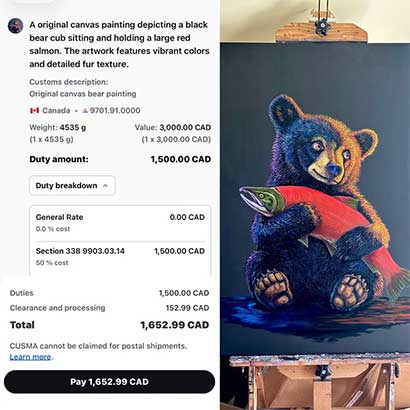
A New 50% U.S. Tariff on Original Canadian Art
In July 2026, the U.S. administration issued Section 338 proclamations imposing an additional 50% tariff on specified Canadian products. Following a temporary suspension, the additional duties took effect on August 22, 2026. The White House states that these tariffs apply to covered products even when they would otherwise qualify under the U.S.-Mexico-Canada Agreement. Read the White House Section 338 tariff announcement
Most importantly for Canadian artists, the official tariff annex specifically includes HTS 9701.91.00, covering paintings, drawings and pastels executed entirely by hand. View the official White House tariff annex listing 9701.91.00
U.S. Customs and Border Protection has also classified Canadian oil paintings under HTSUS 9701.91.0000. See the U.S. Customs classification records for original paintings
For a Canadian artist, those numbers can sound technical.
For me, they became very personal.
What Does a 50% Art Tariff Mean for a Collector?
Consider an original Canadian painting with a customs value equivalent to $3,000 CAD.
Before these new Section 338 measures, an original painting under this tariff classification carried a free underlying duty rate.
Where the additional 50% Section 338 duty now applies, the basic illustration looks like this:
Original painting: $3,000 CAD
Additional 50% tariff: approximately $1,500 CAD
Combined amount before shipping, brokerage and other applicable import expenses: approximately $4,500 CAD
That is an extraordinary difference for an American collector who simply wants to purchase a one-of-a-kind painting from a Canadian artist.
And it can change whether the sale is financially realistic at all.
I Discovered the Tariff Impact Almost by Accident
What surprised me most was how unexpectedly this affected my business.
In the media leading up to the tariff deadline, I heard discussions about manufactured products, building materials, hockey sticks and other industries.
I wasn’t thinking about oil paintings.
Then I saw a television story about a Canadian artist being affected by the new tariffs.
My first thought was that the story must involve reproductions or commercially printed artwork rather than handmade original paintings.
So I checked.
I entered one of my paintings—which an American collector had already shown interest in—into the customs and tariff calculation system I use for international shipments.
The result stopped me in my tracks:
50%.
Suddenly, an American market I had spent years developing looked completely different.
Why This Matters to a Working Canadian Artist
For governments and multinational corporations, international trade is often discussed in billions of dollars.
For an independent artist, one sale matters.
One of my original oil paintings may represent 80 to 100 hours of work.
There is research, drawing, composition, colour selection, canvas preparation, multiple layers of oil paint, texture and countless individual brushstrokes before a painting ever reaches a collector.
You can see how those factors influence the value of handmade artwork in my guide to how much original Canadian art costs.
American collectors had become an increasingly important part of my business.
Two of my recent original paintings went to collectors in Washington and Texas.
The Texas painting provides a particularly good example of what could now become considerably more difficult.
A Whistler Commission That Could Be Much Harder Today
My Texas collector had travelled to Whistler, British Columbia and wanted something meaningful to remember his experience.
He discovered my artwork online and contacted me directly about creating a custom painting.
Together, we developed the idea for a one-of-a-kind Whistler Blackcomb oil painting based on a place and experience that meant something personally to him.
Over the following weeks, I designed and painted the original artwork and eventually shipped it from British Columbia to Texas.
I have documented the entire experience in my Whistler commission collector story.
This wasn’t simply another piece of home décor.
It represented his memories of Whistler.
That is one of the reasons I love creating custom art commissions. A painting can preserve a ski trip, landscape, wildlife encounter, family location or another experience that may remain meaningful for decades.
Now imagine adding a 50% tariff to the customs value of a similar painting.
For many collectors, that could turn a meaningful purchase into something financially unrealistic.
For me, it means I can no longer assume that growing my American collector base will be as dependable a part of my business strategy.
Buy Canadian Art: My Business Is Pivoting Back Toward Canada
This is perhaps the strangest part of international trade when you operate a small creative business.
Something happening at the governmental level can suddenly reach directly into an artist’s studio.
With the stroke of a pen, I have had to reconsider where I find my future collectors.
My focus is now moving much more heavily toward Canada and Canadian collectors.
Fortunately, I already have collectors across the country.
My British Columbia landscapes connect with people who have memories of Vancouver, Whistler and the West Coast. My wildlife paintings of bears, wolves, eagles and other Canadian animals have found homes with collectors far beyond British Columbia.
Recently, I sold two substantial original paintings within Canada.
One travelled from Vancouver all the way to Halifax.
Another went north to Squamish.
Those sales make me optimistic.
There is a strong Canadian market for meaningful original artwork.
My challenge now is to reach more Canadians who may not yet realize how accessible collecting original art can be.
Collectors who are just beginning can also read my guide to buying Canadian art, which explains how to choose artwork you will still enjoy years from now.
Buying Canadian Art Has a Ripple Effect
When someone purchases an original Canadian painting, the economic impact extends much further than the artist.
Take one of my own paintings.
I purchase canvases, oils and art materials through Canadian suppliers and local retailers.
Packaging and delivery involve other businesses.
Canadian shipping companies and workers may transport the artwork.
Local galleries provide places where the public can experience art in person.
Framers, photographers, printers, exhibition organizers, website professionals and other creative businesses can all become part of the ecosystem surrounding one working artist.
A collector who walks into a local gallery to see one of my paintings may also discover another Canadian artist whose work they love.
That is what can get lost when people talk about buying locally.
A dollar spent with a Canadian artist does not necessarily stop with the artist.
It moves through a community.
Canada’s tariff response itself illustrates how broadly the current trade dispute reaches. The Government of Canada says the U.S. Section 338 tariffs cover approximately $27.6 billion in Canadian goods, and Canada has announced corresponding countermeasures. Read the Government of Canada’s tariff response
For an independent artist, “Buy Canadian” isn’t an abstract slogan.
It can affect whether Canadian creative businesses continue to grow.
Why Buying Canadian Art Is About More Than Economics
This part matters even more to me.
Canadian art is storytelling.
I am a Canadian landscape and wildlife painter, and much of my work comes from what I have personally experienced during more than 25 years living on Canada’s West Coast.
You can see that range in my Canadian art portfolio.
When I paint Whistler, Vancouver, a grizzly bear or a mountain landscape, I am not trying to create a photographic copy.
I am painting my interpretation of Canada.
Colour, movement, weather and memory become part of the painting.
That is where original art begins to have cultural value as well as decorative value.
And occasionally a painting becomes a piece of historical documentation without the artist necessarily realizing it at the time.
Painting Vancouver History
One of my original Vancouver paintings depicts the historic Hudson’s Bay building in downtown Vancouver on a dark, stormy night.
The pavement is wet.
Streetlights and illuminated signs reflect through the rain.
Colour emerges from what could otherwise appear to be a gloomy Vancouver evening.
This fascination with rain, architecture and reflected light appears throughout my collection of Vancouver cityscape paintings.
When I created the Hudson’s Bay painting, I was painting a familiar Canadian landmark.
But buildings, companies and cities change.
Over time, artwork can become a record of how a place looked and how an artist experienced it during a specific period.
A collector purchased that original painting.
Perhaps it will remain in that family for generations.
That possibility fascinates me.
Long after I am gone, someone may look at one of my paintings and see how one Canadian artist interpreted Vancouver, Whistler or Canadian wildlife during this particular period of our history.
That is cultural value that is difficult to put into a spreadsheet.
Why Buy Original Canadian Art Instead of Mass-Produced Décor?
I often speak with people who are considering buying their first original artwork.
One thing I tell them is:
You don’t need the more expensive option.
Supporting Canadian artists doesn’t mean purchasing the biggest painting in the gallery.
I would rather someone find a smaller handmade artwork that genuinely means something to them than spend money on something simply because it matches their sofa.
Mass-produced décor has its place.
But an original painting is fundamentally different.
There is one.
Every brushstroke happened once.
Every layer was placed by the artist.
Every decision becomes part of the physical object.
When one collector purchases an original, nobody else can own that exact painting.
In a world increasingly filled with AI imagery, print-on-demand products, endless digital content and mass-produced décor, I believe handmade objects are becoming more meaningful, not less.
My available one-of-a-kind original paintings are created with exactly that philosophy.
Original Art Should Mean Something
The best art purchase isn’t necessarily the artwork that matches the furniture.
It is the one that makes you feel something.
Perhaps it reminds you of:
the mountain where you learned to ski;
the neighbourhood where you grew up;
a bear you once watched in British Columbia;
a hockey or sporting memory;
a family holiday;
a favourite Canadian landscape; or
a place connected to someone important in your life.
Those experiences are also wonderful starting points for commissioning an artist.
Some of my favourite projects have started with collectors asking me to preserve a personal memory through a one-of-a-kind painting.
The subject doesn’t have to matter to everyone.
It only has to matter to you.
If you are considering that route, my commission painting process explains how an idea moves from conversation and reference photographs to a finished original oil painting.
Buying Directly From Canadian Artists
There are many good ways to support Canadian art.
Galleries are extremely important. They create communities, introduce collectors to artists and allow people to experience paintings in person.
I exhibit through galleries myself.
But collectors should also understand the economics of purchasing art.
Gallery commissions can represent a significant percentage of the selling price. When a collector purchases directly from an artist, more of that purchase can go directly to supporting the artist’s practice.
There is another benefit that is just as important:
You can get to know the person who made the art.
Call them.
Email them.
Meet them when possible.
Ask why they painted something.
Ask what inspired it.
I love speaking with collectors.
That direct connection is a major part of how I work, and you can learn more about my background and approach on my Canadian artist biography.
Once you understand the story behind a painting—and the artist understands something about why it matters to you—the artwork can take on a completely different meaning.
You Don’t Need a Huge Art Budget to Support Canadian Artists
If you love Canadian art but cannot spend thousands of dollars, don’t let that stop you.
Work within your budget.
Visit local exhibitions and markets.
Discover Canadian artists online.
Follow their careers.
Share their work.
Talk to them.
Buy a small original when the right one appears.
Consider a commission later.
A smaller original painting can carry exactly the same human connection as a large canvas.
The important thing isn’t its size or price.
The important thing is that someone made it by hand and it means something to you.
That is why I encourage collectors to think first about connection and then about budget.
Could “Buy Canadian Art” Strengthen Canada’s Art Market?
I believe it could.
This is an unusual and historic moment in Canada’s relationship with the United States.
Governments will change.
Trade policies may change.
Tariffs may eventually disappear or be modified.
And I certainly do not view American collectors through the lens of a political dispute. I have met wonderful people throughout the United States, and I value those relationships enormously.
But recent events have reminded me of something important:
Canadians need to support one another.
That includes farmers.
Manufacturers.
Independent retailers.
Tradespeople.
Restaurants.
And artists.
If more Canadians intentionally discover and purchase work made by Canadian artists, we could potentially emerge from this period with a stronger domestic arts community.
My Pivot: Canada First, Then the World
For my own art business, I am going to put considerably more energy into reaching Canadian collectors.
That means participating in exhibitions, art festivals and markets.
It means continuing to develop my online presence.
It means reaching collectors in Vancouver, Whistler and British Columbia while making it easier for someone in Halifax, Toronto, Calgary, Montreal or anywhere else in Canada to discover and purchase my work.
My official Canadian art website now plays an increasingly important role in making that direct connection possible.
I will also explore other international markets.
I have previously sold paintings to collectors in the United Kingdom, and I believe opportunities may exist in Europe and Asia.
Shipping large canvases internationally brings its own challenges.
But artists adapt.
We always have.
Buy Canadian Art. Support Canadian Artists.
Ultimately, buying Canadian art matters for two reasons.
It supports our economy.
But it also preserves our culture.
An original Canadian painting can capture a place, an animal, a memory or a moment in our history.
It can hang in someone’s home for decades.
Children may grow up looking at it.
Eventually, it may pass to another generation.
That is something I think about every time I paint.
Every brushstroke is a personal signature from a moment in time.
Perhaps decades from now, some of those paintings will become small pieces of Canada’s cultural history.
Buy Canadian. Support Canadian artists. But most importantly, find something made by a human being that genuinely means something to you.
That is the kind of purchase you may still be grateful for many years from now.
Frequently Asked Questions About Buying Canadian Art
Are original Canadian paintings subject to a 50% tariff when imported into the United States?
Certain Canadian-origin products covered by the U.S. Section 338 measures are subject to an additional 50% duty. The official U.S. tariff annex specifically lists HTS 9701.91.00, which includes paintings, drawings and pastels executed entirely by hand. View the official White House tariff annex
Because tariff measures can be amended, suspended or terminated, artists and collectors should verify current customs treatment before shipping an artwork.
Do the Section 338 tariffs apply even if Canadian goods qualify under CUSMA/USMCA?
The White House states that the Section 338 tariffs apply to covered goods regardless of whether the product originates under USMCA. Read the White House tariff fact sheet
How much could a 50% tariff add to a $3,000 Canadian painting?
If the applicable customs value were equivalent to C$3,000, a 50% ad valorem tariff would represent approximately C$1,500 in additional duty, before shipping, brokerage and any other applicable import expenses.
What tariff classification applies to an original Canadian oil painting?
U.S. Customs and Border Protection has previously classified Canadian oil paintings under HTSUS 9701.91.0000. View U.S. Customs classification records
The precise classification and customs treatment of an individual shipment should always be confirmed based on the artwork and current regulations.
Why should I buy Canadian art?
Buying Canadian art supports working artists while helping sustain galleries, art-supply retailers, framers, shipping companies, exhibitions and other businesses within Canada’s creative economy.
It also helps preserve Canadian cultural stories, landscapes, wildlife, communities and personal experiences through original handmade objects.
Where can I buy Canadian art online?
Collectors can purchase artwork directly from individual Canadian artists, through galleries and through reputable art marketplaces.
If you are interested in my own work, you can begin with my Canadian art buying guide or browse my available original paintings.
Is buying directly from a Canadian artist better than buying through a gallery?
Both can support Canadian art.
Galleries play an important role in exhibiting artists and creating cultural communities. Buying directly from an artist can provide a more personal collector experience and allows you to communicate directly with the person who created the artwork.
Do I need a large budget to buy original Canadian art?
No.
Buy within your budget.
A smaller handmade original that carries genuine personal meaning can be a better purchase than a larger or more expensive artwork that does not connect with you.
For a realistic overview of prices, see my guide to how much original Canadian art costs.
Can I commission a Canadian artist to paint a personal memory?
Yes. Many artists accept custom commissions.
I create commissioned oil paintings inspired by Canadian landscapes, wildlife, Whistler and ski memories, Vancouver locations and other personally meaningful experiences. You can read about my custom oil painting commission process or see the real-world Texas Whistler collector commission.