Canadian Artist Graham Watts
Vancouver & Whistler, BC
Call (604) 200-0170
- Portfolio
- Shop Art
- Commissions
- About
- Art Journal
- Buy Canadian Art: Why Supporting Canadian Artists Matters More Than Ever
- Whistler Art Commission: A Collector Story | Graham Watts
- Where to Buy Canadian Art Online
- Canadian Oil Painting Prices: How Much Does Original Canadian Art Cost?
- Wildlife Artist: A Message of Wonder and Respect
- How to Commission a Whistler Mountain Painting
- What Makes Mountain Paintings Different From a Photograph?
- How Artists Make High-Quality Prints of Oil Paintings
- Canadian Artwork Tax Deduction
- What Size Painting for a Vancouver Condo? | Artist’s Size Guide
- Why Art Matters: What Collectors Have Taught Me as a Canadian Artist
- Contact
Wall Art Size Guide: What Size Original Painting Works in a Vancouver Condo?
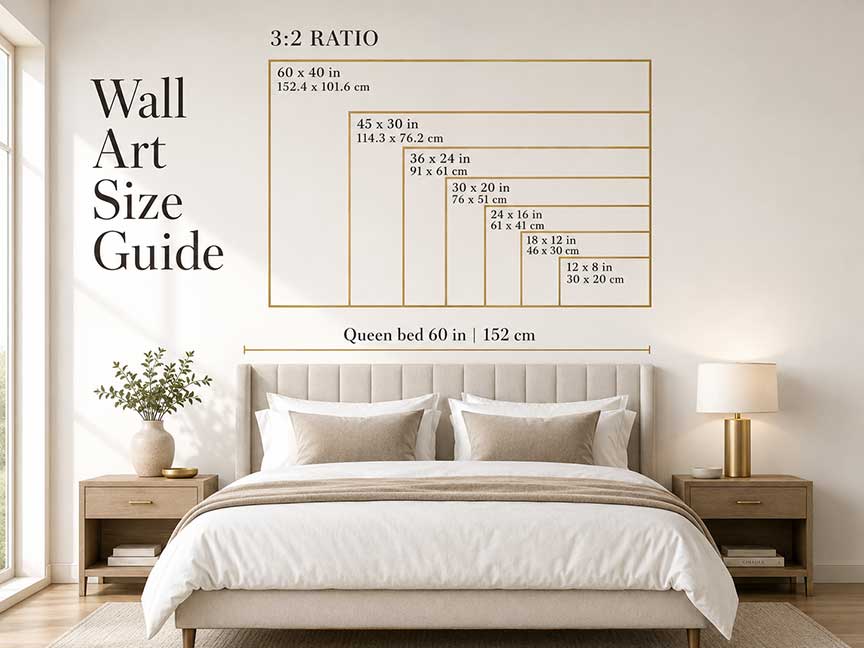
An Artist’s Guide to Choosing the Right Painting Scale for Your Wall
One of the most common questions I hear from collectors is whether their condo is too small for a larger original painting. In this wall art size guide, I explain why the opposite problem is often more common: the artwork is simply too small for the wall. A 30 × 40-inch original painting can work surprisingly well in a Vancouver condo when the scale is considered in relation to the wall, furniture, ceiling height, surrounding architecture, and viewing distance.
In my experience, the opposite problem is often more common: the artwork is too small for the wall.
A 30 × 40-inch original painting can work surprisingly well in a Vancouver condo when it has enough clear wall around it and can be viewed from an appropriate distance. Rather than recommending artwork based only on the square footage of a home, I look at the actual wall, the furniture beneath it, the ceiling height, the surrounding architecture and where the painting will normally be viewed from.
When a collector is unsure, I usually ask for a straight-on photograph of the wall and its measurements. I can then create a digital room mock-up showing the artwork at different sizes before they make a decision.
That often makes the right scale immediately obvious.
If you are already considering a painting, you can view my available original paintings or contact me directly and send me a photograph of your wall.
Is a 30 × 40 Painting Too Large for a Condo?
Usually, no.
A 30 × 40-inch painting is large enough to create a strong focal point without requiring an enormous room. It is a size I use frequently because it gives me enough canvas to create depth, texture and visual impact while still fitting comfortably on many residential walls.
Whether a 30 × 40 painting works has much less to do with the total size of the condo than people sometimes assume.
I am usually more interested in questions such as:
- How wide is the usable section of wall?
- Is there furniture below the painting?
- How high is the ceiling?
- Are there windows, shelves or architectural features nearby?
- How far away will you normally stand or sit when viewing the painting?
- Is the painting horizontal, square or vertical?
- Will it be framed?
A relatively compact Vancouver condo can easily have a wall where a 30 × 40-inch original looks completely natural.
You can see examples of the different sizes and formats I work with in my collection of original paintings.
Measure the Wall, Not Just the Room
When someone tells me, “My condo is only 700 square feet,” that does not actually tell me very much about the appropriate painting size.
Two condos with exactly the same square footage can have completely different wall configurations.
One might have a large uninterrupted living-room wall. Another may have windows, patio doors, shelving and architectural columns dividing the available space.
For that reason, I prefer to measure the usable wall area rather than make assumptions based on the size of the home.
A smaller home does not automatically require smaller artwork.
In some cases, one substantial painting can actually make a compact room feel calmer and more intentional than several smaller pieces competing for attention.
What Size Painting Should Go Above a Sofa?
A useful starting point is to choose artwork that measures approximately two-thirds to three-quarters of the width of the furniture beneath it.
For example, if a sofa is 72 inches wide, artwork somewhere around 48 to 54 inches wide can be a reasonable starting point.
I treat that as a guideline rather than a strict rule.
The right size also depends on:
- the width and height of the wall
- ceiling height
- surrounding furniture
- the orientation of the painting
- whether the artwork is framed
- the strength of the colours and composition
A highly detailed or strongly coloured painting can sometimes feel visually larger than its actual dimensions.
A quieter painting may need more physical scale to create the same presence.
The goal is not to satisfy a mathematical formula. It is to make the painting feel intentional within the room.
How I Help Collectors Choose the Right Painting Size
When someone is considering one of my original paintings or thinking about a custom art commission, I often use a simple process.
1. Send Me a Straight-On Photograph of the Wall
The photograph should ideally be taken directly in front of the wall rather than from an angle.
This makes it easier for me to estimate proportions accurately.
2. Measure the Usable Wall
I usually want the approximate width and height of the area where the artwork might hang.
There may be a much larger wall physically, but windows, light switches, shelving, doors or furniture can reduce the area that actually matters.
3. Measure the Furniture Beneath It
If there is a sofa, bed, console or cabinet below the painting, knowing its width helps establish proportion.
4. Think About Where You Will Normally See the Painting
A painting is rarely experienced from one position.
You might normally see it:
- while sitting on the opposite sofa
- from the kitchen
- when entering the condo
- from the dining table
- while walking through the room
5. Compare Different Painting Sizes
I can digitally place a painting into your photograph and compare several possible dimensions.
For example:
- 24 × 30 inches
- 30 × 40 inches
- 36 × 48 inches
Seeing those options in the actual room is usually far more useful than trying to imagine the difference from measurements alone.
This is also part of the process I use when creating a commissioned original oil painting.
Viewing Distance Matters More Than Many People Realize
A painting is rarely experienced from only a few inches away.
In an open-plan Vancouver condo, an artwork may be viewed from eight, ten or even fifteen feet across the living and dining space.
That viewing distance can make a larger painting feel surprisingly natural.
A 30 × 40-inch painting viewed from across a room may not feel particularly large at all. Instead, it can act as a clear visual anchor.
This is one reason I am cautious about automatically recommending small paintings for small homes.
Sometimes increasing the size creates a simpler and more cohesive room.
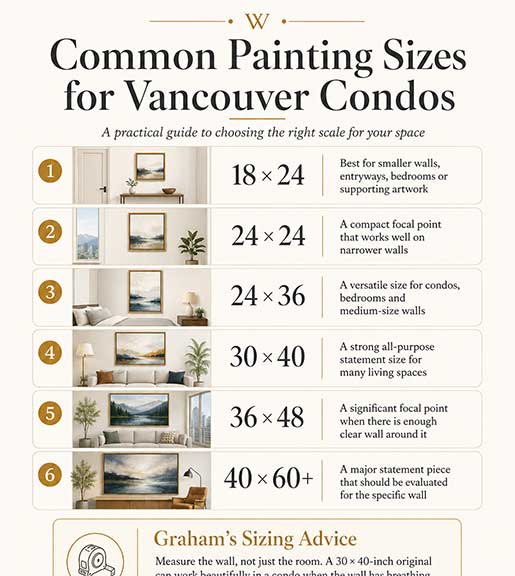
How I Think About Common Painting Sizes
There is no universal rule, but these are the general ways I think about several common canvas sizes when helping collectors.
| Painting Size | How I Generally Think About It |
|---|---|
| 18 × 24 inches | Useful for smaller walls, bedrooms, entryways or secondary artwork |
| 24 × 24 inches | Compact focal point that can work particularly well on narrower walls |
| 24 × 36 inches | A versatile size for condos, bedrooms and medium-size walls |
| 30 × 40 inches | A strong all-purpose statement size for many living spaces |
| 36 × 48 inches | A significant focal point when there is enough clear wall around it |
| 40 × 60 inches and larger | A major statement piece that should usually be evaluated for the particular wall |
These are not universal decorating rules.
They are simply how I think about the canvas sizes I regularly work with as a Canadian oil painter.
You can compare some of these formats by browsing my available original artwork.
One Large Painting or Several Smaller Pieces?
Both approaches can work beautifully.
But if a collector wants one artwork to become the main focal point of a room, I usually recommend exploring a substantial single painting before automatically filling the wall with several small pieces.
Every frame, edge and gap in a group of artworks introduces another visual element.
One large original can give the eye a place to rest.
This can be particularly effective in a condo where the living room, dining room and kitchen are visually connected.
Several smaller paintings can work extremely well too, especially when they have a strong relationship to one another.
The important thing is that the choice feels intentional.
You Do Not Always Need the Larger or More Expensive Option
One of the benefits of creating a room mock-up is that it can reveal when the smaller painting is actually the better choice.
If that is what I see, I will say so.
The goal is not to put the largest or most expensive painting on the wall.
You do not need the more expensive option if the smaller painting is the better fit.
Sometimes a 24 × 30-inch painting is exactly what the room needs.
Sometimes the same wall clearly benefits from a 30 × 40.
Being able to compare them before purchasing removes much of the guesswork.
If you would like an opinion on a particular painting, contact me and send a photograph of your wall.
Horizontal, Square or Vertical?
The orientation of a painting can matter almost as much as its dimensions.
Horizontal Paintings
Horizontal paintings often work naturally above:
- sofas
- beds
- consoles
- long dining-room walls
Many mountain landscapes, Vancouver cityscapes and ski paintings naturally lend themselves to this format.
Square Paintings
Square artwork can be particularly useful in condos because it creates significant presence without requiring an extremely wide wall.
A 30 × 30 or 36 × 36-inch painting can make a very strong focal point.
I also use square canvases regularly for wildlife paintings because the proportions can create a powerful relationship between the animal and the viewer.
Vertical Paintings
Vertical paintings can work beautifully on:
- narrower wall sections
- entryways
- walls between windows
- stair landings
- walls beside consoles or architectural features
Sometimes the shape of the wall provides the answer before the subject of the painting does.
Does a Frame Change the Size Decision?
Yes.
A frame adds to the overall visual footprint of a painting.
A 30 × 40-inch gallery-wrapped canvas will occupy less wall space than the same painting inside a substantial frame.
Floating frames generally add less visual weight than heavy traditional frames, but they still change the overall dimensions.
When I create a room visualization, I prefer to represent the finished presentation whenever possible rather than considering only the raw canvas dimensions.
That gives the collector a better sense of what the artwork will actually look like once it is installed.
How High Should an Original Painting Hang?
A useful starting point is to position artwork so that its visual centre sits somewhere around normal eye level.
When a painting is above a sofa, console or other piece of furniture, I also want it to feel visually connected to the furniture rather than floating unusually high above it.
I generally pay more attention to how the artwork relates to the room than following any single measurement rigidly.
A painting should feel like it belongs to the space around it.
What About a Vancouver Condo With a Great View?
This is a particularly interesting question in Vancouver.
Many homes already have dramatic views of the North Shore mountains, ocean, city skyline or surrounding landscape.
I do not necessarily think artwork needs to compete with that view.
Sometimes a painting works best on an adjacent wall, where it becomes part of the visual rhythm of the room rather than trying to overpower the window.
A British Columbia landscape or wildlife painting can also create an interesting relationship with the environment outside.
My own work is strongly influenced by Vancouver, Whistler and the Sea-to-Sky landscape, so I am particularly interested in that relationship between the artwork, the home and the landscape beyond it.
You can explore more of these subjects throughout my original painting collection.
Natural Light Matters Too
Large windows are one of the great features of many Vancouver condos, but they can affect how artwork is experienced.
Strong daylight changes throughout the day and can influence:
- colour
- glare
- shadows
- contrast
- how strongly a painting appears against the wall
Oil paintings also have physical surface texture, and changing light can reveal that texture differently throughout the day.
When possible, I like to understand where the windows are in relation to the proposed artwork.
A Real Room Is Better Than a Generic Size Chart
Size charts can be useful starting points.
But the most reliable way to decide whether a particular painting works in a particular home is to look at the actual space.
That is why I encourage collectors to send me a photograph.
Once I can see the room, I can usually make a much more useful recommendation than I could from measurements alone.
The conversation often becomes very simple:
“This one feels too small.”
“This one overwhelms the wall.”
“This size feels right.”
That is much more useful than trying to force every room into the same mathematical formula.
Can Large Art Work in a Small Room?
Absolutely.
Large artwork does not automatically make a room feel smaller.
In fact, one substantial painting can sometimes make a compact room feel calmer because it creates one clear focal point rather than numerous smaller visual elements.
The key is allowing the painting enough visual breathing room.
If every wall is already visually busy, adding another large object may feel overwhelming.
But when a painting is given a clear wall and allowed to become the focal point, larger scale can be extremely effective.
Should the Painting Match the Furniture?
I do not think artwork needs to match a sofa, rug or cushions perfectly.
A painting should have enough relationship with the room that it feels comfortable there, but that does not mean repeating exactly the same colours.
Original artwork can introduce contrast, personality and energy.
I would rather see a collector choose a painting they genuinely connect with than select something simply because its colours match the furniture.
Furniture may eventually change.
A meaningful original painting may stay with you for decades.
My Advice Before Buying a Large Original Painting
If you love a painting but are uncertain about its size, do not rely entirely on imagination.
Measure the wall.
Take a photograph.
Compare the artwork visually at scale.
If necessary, use painter’s tape to outline the proposed dimensions directly on the wall.
A 30 × 40-inch rectangle becomes much easier to understand when you can actually see those dimensions in the room.
And if you are considering one of my paintings, you are welcome to contact me directly and send me a photograph of the wall.
I would much rather help you choose the right size before you purchase than have you wonder afterward whether another size would have worked better.
Frequently Asked Questions About Choosing Painting Size
Is a 30 × 40 painting too large for a condo?
In many cases, no. A 30 × 40-inch painting can work very well in a condo when the wall has enough clear space around it. Wall dimensions, furniture placement and viewing distance are usually more important than the overall square footage of the home.
What size painting should I hang above a sofa?
A useful starting point is artwork approximately two-thirds to three-quarters of the sofa’s width. I treat this as a guideline rather than a strict rule because the wall, ceiling height, framing and visual strength of the painting also affect the result.
Can a large painting work in a small room?
Yes. One large painting can sometimes make a compact room feel more cohesive because it creates a single focal point rather than many smaller visual elements.
How can I see what a painting will look like on my wall before buying it?
Send me a straight-on photograph of your wall along with its approximate measurements. I can create a digital room mock-up showing the artwork at scale so that you can compare different sizes before making a decision. Contact me here.
Does a frame count when choosing painting size?
Yes. A frame increases both the physical dimensions and visual weight of the artwork, so I recommend considering the finished framed size rather than only the dimensions of the canvas.
Is one large painting better than several small paintings?
Neither option is universally better. If you want one strong focal point, a larger original painting can create a clean, cohesive look. Multiple smaller works can be effective when they are intentionally grouped and relate well to one another.
Can Graham help me determine the size of a commissioned painting?
Yes. Choosing the appropriate canvas size is part of my custom commission process. We can discuss the wall, room, dimensions and subject and use a digital mock-up to help determine what scale works best.
Not Sure What Size Painting Will Work?
If you are considering one of my available original paintings—or thinking about commissioning a custom piece—send me a straight-on photograph of your wall along with its approximate dimensions.
I can help you compare canvas sizes and visualize how the artwork may look in your home before you make a decision.
You do not need the more expensive option if the smaller painting is the better fit.
The goal is simply to find the painting that belongs in your space.
View Available Original Paintings
Explore Custom Art Commissions
View Commission Sizes & Pricing
Contact Graham & Send a Photo of Your Wall