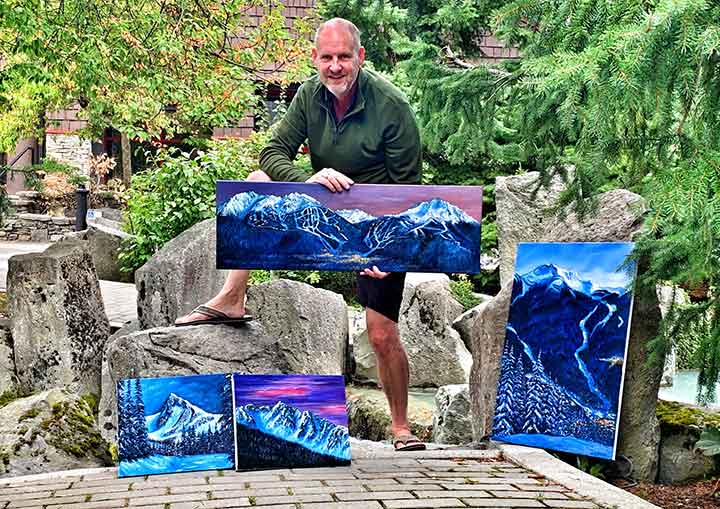
Art rooted in the wild character of Canada.
Graham creates luminous wildlife, mountain landscapes and cinematic city scenes shaped by Vancouver, Whistler and the Sea-to-Sky.
I generally see the world in colour.
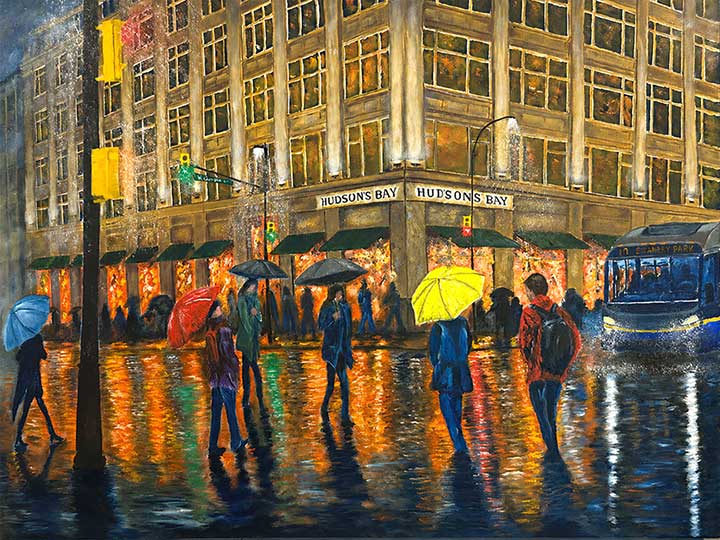
Something will catch my attention while I’m walking the streets of Vancouver, hiking in the mountains, skiing or observing wildlife. It may be the geometry of a mountain face, the movement of a skier, the personality of an animal or brilliant colour reflecting from a wet Vancouver street.
That moment becomes the beginning of a painting.
I work primarily within four subjects Canadian wildlife, mountain landscapes, Vancouver and Whistler cityscapes, and skiing and snow sports but I continually move between them depending on what interests me and where I want to push my work next.
I’m not trying to recreate a photograph.
When I paint, I want to make a statement. I use colour, texture, light and depth to communicate something of what it felt like to actually experience the subject.
A photograph can capture a mountain at a fraction of a second. But stand in front of that mountain for a day and it continually changes. As the sun moves, new crevices appear, rock faces emerge, shadows deepen and colours shift.
Those are the things that fascinate me.
Painting is a puzzle. Each canvas asks me to observe more closely, understand the subject more deeply and find a way to translate a three-dimensional experience onto a two-dimensional surface.
I paint what moves me, and I hope something in the finished painting moves you too.
~ Graham Watts.

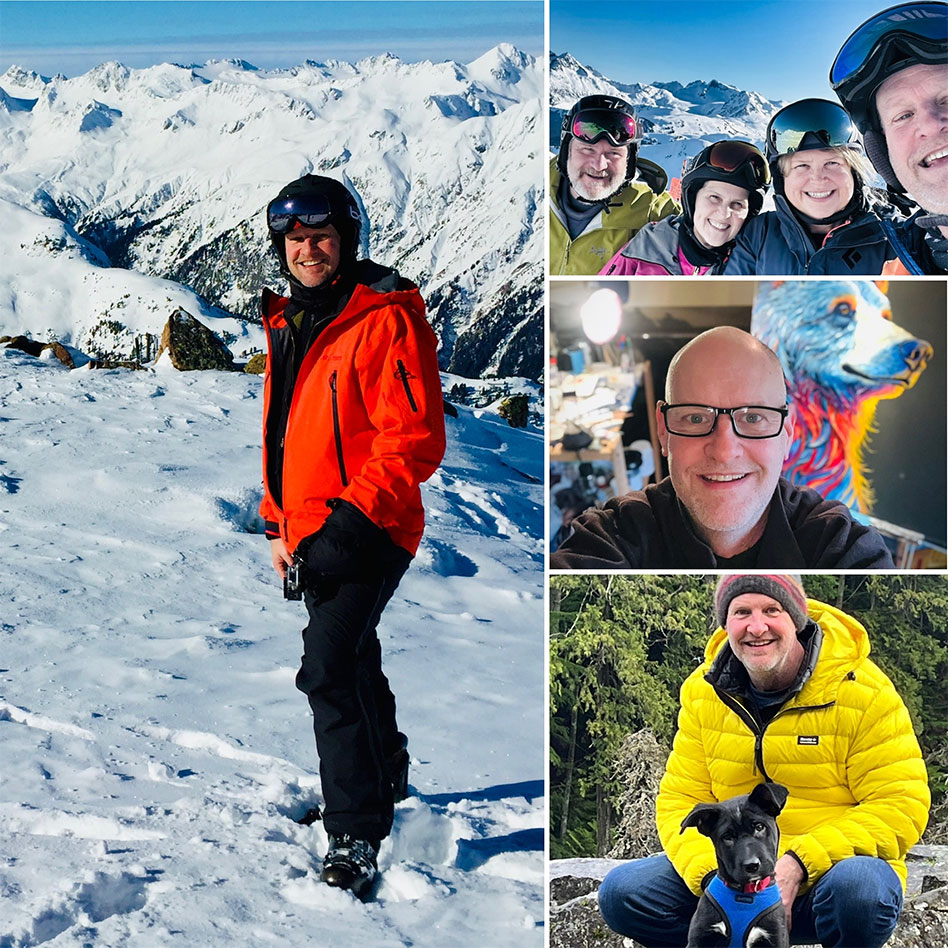
Originally from Guelph, Ontario, Graham moved to British Columbia more than 25 years ago. The mountains, forests, ocean and wildlife soon became central to both his life and his work.
As a skier, hiker and watersports enthusiast, he spends time in the places he paints. A mountain view, the movement of a skier in deep snow, a wildlife encounter or the glow of city lights on wet pavement can all become the beginning of a painting.
That firsthand connection gives the work its sense of place. The subjects are unmistakably Canadian, but each painting is filtered through Graham’s own memory, optimism and emotional response.
Graham’s path to becoming a professional artist was not a traditional one. He earned a BA in Management Economics from the University of Guelph and later completed an Internet Marketing Certificate at the University of British Columbia. His career went on to span marketing, technology and entrepreneurship, including work with The Coca-Cola Company, co-founding Vancouver-based Urban Poling Inc., and operating his own digital marketing business.
Art remained a constant throughout those years. Self-taught in oil painting, Graham began more than 20 years ago with a small canvas and three tubes of paint. What started as exploration gradually developed into a professional art practice and the distinctive approach to colour, texture and light that defines his work today.
When I paint a mountain, I want to understand the mountain not simply copy a photograph of it.
Standing in front of a mountain peak is a three-dimensional experience. Light travels across its surface throughout the day, revealing ridges, crevices and rock faces that may disappear entirely from another angle or under different light.
Before beginning some mountain paintings, I use photographs, firsthand observations, Google Earth and 3D modelling to rotate around the peak and better understand its geometry.
Much of that research will never be obvious to the person looking at the finished painting.
But it matters to me.
Once I understand the structure, I begin translating it onto canvas. I use layers of oil paint, saturated colour, changes in value and physical texture to draw the form forward and create depth.
At times it feels less like applying paint and more like sculpting or chiselling the subject out of the canvas.
The process often begins outside the studio. Walking Vancouver, hiking, skiing or experiencing wildlife gives me the initial idea. I gather reference material and pay attention to light, movement, scale and colour.
Before painting, I study the subject. With mountain work in particular, I may examine different viewpoints and 3D geometry to understand what is happening beyond the single perspective captured by a photograph.
Then I paint.
I deliberately push colour, contrast, texture and depth. Not simply to make the image more dramatic, but to communicate something a photograph often cannot—the physical and emotional experience of being there.
Every painting is also an experiment.
The way I paint today is quite different from how I painted five or ten years ago. I want that evolution to continue.
Part of what keeps me painting is the curiosity of wondering what my work will look like five or ten years from now.
Graham’s visual language is informed by the bold design and Canadian spirit of Lawren Harris, Emily Carr and E.J. Hughes, interpreted through a contemporary use of colour and cinematic light.
Wildlife, mountain country and the city after rain form a connected portrait of British Columbia.
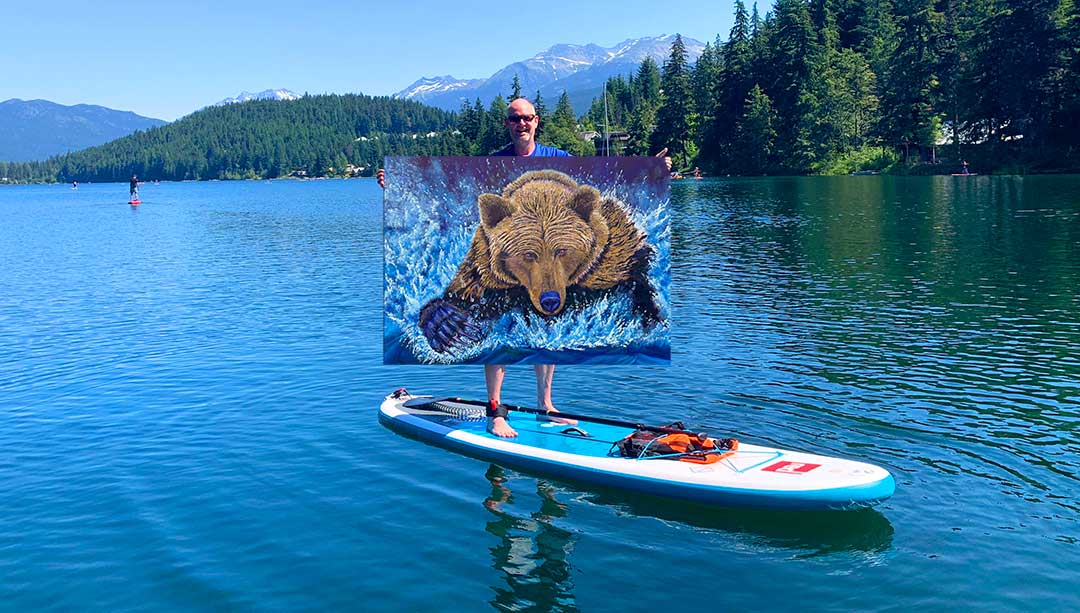
Bears, wolves, eagles and elk are treated as distinct personalities—direct, alert and emotionally immediate.
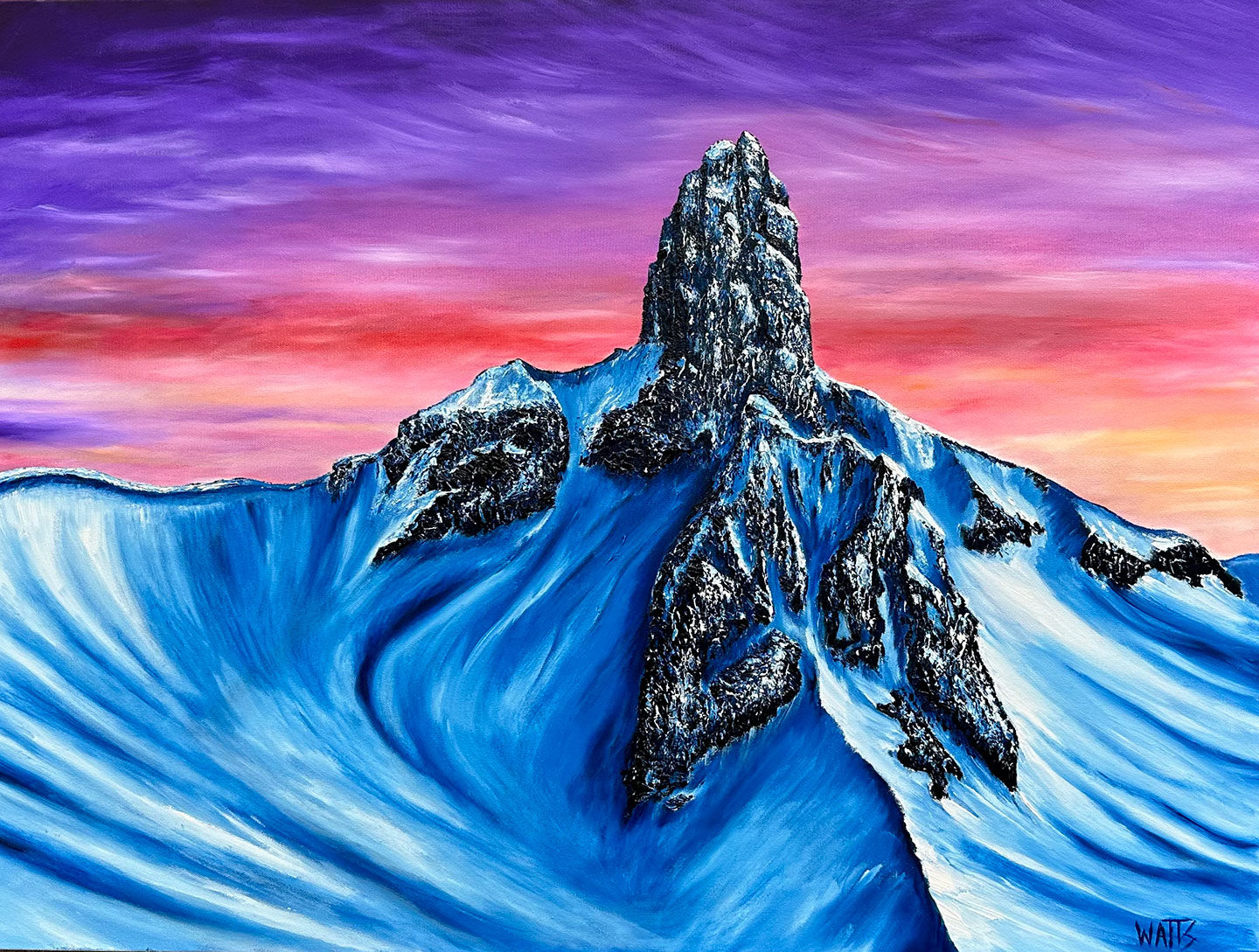
Whistler, Blackcomb, Black Tusk and the Tantalus Range become atmospheric studies of scale, light and freedom.
Reflections, pedestrians and familiar architecture transform everyday city moments into luminous, cinematic scenes.
Graham’s paintings have been exhibited in Vancouver, Whistler and communities throughout British Columbia. Showing the work in person creates something the studio cannot: the chance to hear the memories and emotions a painting brings forward for someone else.
Selected experience
One of my greatest joys as an artist is watching someone experience one of my paintings for the first time.
Their reaction can affect me deeply not because it strokes my ego, but because something I originally created for myself has suddenly created an emotional response in another person.
It might be the subject. It might remind them of a place or experience. It might be the colour, texture or simply the knowledge that every mark was made by another human being.
Whatever triggered it, for that moment we are sharing an experience.
That is tremendously motivating.
Selling a painting can also be surprisingly bittersweet.
Some paintings represent what I consider my best work, and when one leaves my studio I know I may never experience it in person again. At the same time, I am honoured that someone has chosen to give it a place in their home.
Every original is a signature of a particular moment in my life. It contains decisions I made and marks and brushstrokes made physically by my hand.
Long after that moment has passed and potentially long after I am gone the painting can remain.
The thought that one of those paintings might eventually be passed from one generation of a family to another is pretty special to me.
And saying goodbye to a good painting does something else.
Explore Graham’s complete Canadian art portfolio, or get in touch to ask about a painting, private viewing or meaningful commission.